Cul-de-Sac Alternatives
How cul-de-sacs, courts and dead ends differ, and the turnaround alternatives that cut impervious cover: reduced radii, hammerheads, islands and loops.
PageSizing calculators, practice selection, pollutant removal data, fact sheets and model ordinances — the working layer of stormwater design for engineers, municipal staff and site planners.
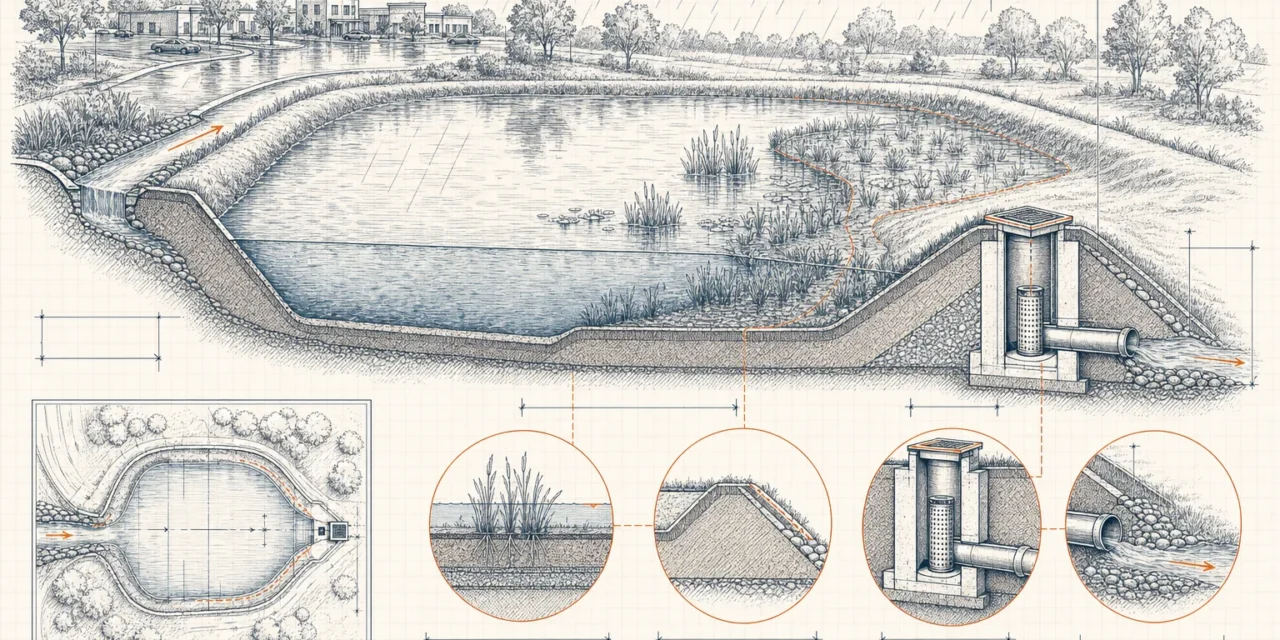
Size a stormwater pond against the full volume stack — water quality, channel protection, overbank and extreme flood — with outlet hydraulics and a fully worked 38-acre example.
Open calculatorDry swale design from definition to detail: channel geometry, engineered soil media and underdrains, check dam spacing, and a fully worked two-fork design example.
Open calculatorAnnual runoff volume and pollutant loads from drainage area and impervious cover.
Open calculatorAnswer seven site questions — drainage area, soils, slope, water table — and get a ranked shortlist of feasible stormwater practices.
Open selectorFilterable performance data for stormwater treatment practices — sediment, nutrients, metals and bacteria, with sources for every value.
Open databaseEvery calculator produces a print-ready worksheet with inputs, intermediate steps and assumptions documented for the project file.
All calculatorsStormwater ponds are the workhorse practices of watershed protection: constructed basins that hold a permanent pool of water, settle out sediment and attached pollutants, and meter out storm flows slowly enough to protect downstream channels. The family covers wet ponds, wet extended detention ponds, micropool designs and multiple-pond systems. Ponds suit drainage areas of roughly ten acres and up, tolerate nearly any soil group, and deliver some of the most reliable monitored performance of any practice group — median removal of about 80 percent of suspended sediment and half of total phosphorus. The trade-offs are land consumption, permanent standing water with its safety and mosquito considerations, and embankments that turn the structure into a regulated dam above certain heights. The fact sheets in this group cover applicability, design criteria, outlet works, landscaping and the maintenance schedule that keeps a pond performing past its first decade; the pond design calculator works the full sizing sequence interactively.
View fact sheetsConstructed stormwater wetlands treat runoff the way natural marshes treat floodwater: shallow pools and vegetated benches slow the water, settle solids, and let plants and microbes work on nutrients and metals. The group includes shallow marsh systems, extended detention wetlands, pond/wetland combinations and pocket wetlands. Wetlands want the same drainage area and baseflow security as ponds — a marsh that dries out loses both its vegetation and its treatment — but they reward the extra design care with strong sediment and bacteria removal and the highest habitat value of any practice group. Their footprint is the largest in the toolbox, which is why they appear most often on larger sites, regional facilities and retrofit opportunities where land is available. These fact sheets cover marsh grading, the pondscaping plan that establishes wetland vegetation, sizing rules and the maintenance routine of a living treatment system.
View fact sheetsInfiltration practices return runoff to the ground instead of a pipe: stone-filled trenches, excavated basins and porous pavement that store a storm in void space and let it percolate into the subsoil. When soils cooperate, nothing else matches them — median monitored removal sits near 95 percent for sediment and 80 percent for phosphorus, recharge obligations are met automatically, and there is no surface footprint to mow. The catch is that soils rarely cooperate: these practices demand measured infiltration rates of at least half an inch per hour, several feet of separation to the seasonal water table, and strict exclusion of stormwater hotspot runoff because whatever goes in reaches groundwater. They also clog without disciplined pretreatment and construction-phase protection — the historic failure rates trace almost entirely to sediment let in too early. The sheets in this group cover feasibility screening, sizing, pretreatment chains and the observation-well monitoring that proves a trench is still alive.
View fact sheetsFiltering practices push the water quality volume through an engineered medium — sand, organic matter or a planted soil bed — and collect the treated flow in an underdrain. The family spans surface, underground and perimeter sand filters, organic filters and bioretention cells. Filters are the specialists for small, intensely impervious drainage areas: parking lots, commercial frontage, ultra-urban corners where a pond could never fit, and stormwater hotspots where infiltration is off the table. Sediment removal is excellent and phosphorus removal solid; soluble nitrogen can pass through or even export, which the database rows for this group document honestly. Bioretention doubles as landscaping and has become the default practice of green streetscapes. The price of the small footprint is maintenance intensity — filter surfaces load up and need raking and media replacement on a schedule, not on hope. These sheets cover head requirements, Darcy sizing, media specifications and variant selection.
View fact sheetsOpen channel practices treat runoff while moving it: dry swales with engineered soil beds and underdrains, wet swales that hold a shallow marsh in the channel bottom, and grass channels that provide conveyance with a treatment bonus. They replace curb and gutter along roads and residential streets, which makes them the cheapest practice group per impervious acre where the right-of-way allows — and the only group that actually reduces the pipe network instead of adding to it. Performance hinges on residence time: gentle slopes, check dams and dense vegetation. Water-quality swale medians run around 80 percent for sediment, with the dry swale the strongest variant. Limits are real: channels handle a few acres each, erode when slopes or velocities exceed their design window, and the soggy-yard complaint is the classic symptom of a swale built without its drainage layer. These sheets cover geometry, Manning checks, check dam spacing, vegetation and failure modes.
View fact sheetsStream restoration techniques repair urban channels that decades of unmanaged runoff have carved apart: streambank protection with rootwads and revetments, bank stabilization with live stakes and other bioengineering, grade control structures that arrest downcutting, and flow deflection that steers erosive energy away from failing banks. These practices differ from the rest of the library — they treat the symptom in the stream rather than the cause on the land — and they work best paired with upstream storage and better site design that bring the hydrology back toward something the channel can live with. The techniques here run from boulder and log structures placed by machine to willow cuttings driven by hand, ordered by the shear stress they can survive. Each sheet covers site assessment, material specification, construction sequence and the establishment care that separates restoration from expensive decoration.
View fact sheetsReducing impervious cover at the source — narrow streets, turnaround alternatives, green parking, buffers and zoning.
View guidesSource controls for the pollutants treatment cannot catch — pet waste, car washing, de-icing, spills and drain maintenance.
View guidesHow cul-de-sacs, courts and dead ends differ, and the turnaround alternatives that cut impervious cover: reduced radii, hammerheads, islands and loops.
PageWhy dog waste is a water pollutant, the survey and loading data behind it, and the stations, digesters and ordinances that reduce it.
PageStreambank protection practices armor eroding banks where property or infrastructure is at risk. Covers rootwad revetments, imbricated riprap, boulder revetments, lunkers and A-jacks.
Stream RestorationA maintenance easement conveys the legal right to access private property to maintain a stormwater practice. Definitions, standards, and sample language.
PageWorked sizing example for an infiltration trench — recharge, storage and drawdown checks.
ToolWorked sizing example for a surface sand filter — treatment volume and filter bed area.
Tool| Practice group | TSS | Total P | Total N |
|---|---|---|---|
| Stormwater ponds | 80% | 51% | 33% |
| Stormwater wetlands | 76% | 49% | 30% |
| Infiltration practices | 95% | 80% | 51% |
| Filtering practices | 86% | 59% | 38% |
| Open channels | 81% | 34% | 84% |
The database aggregates published monitoring studies per practice and pollutant. Filter by practice group, pollutant and data vintage; every row links its study.