Cul-de-Sac Alternatives
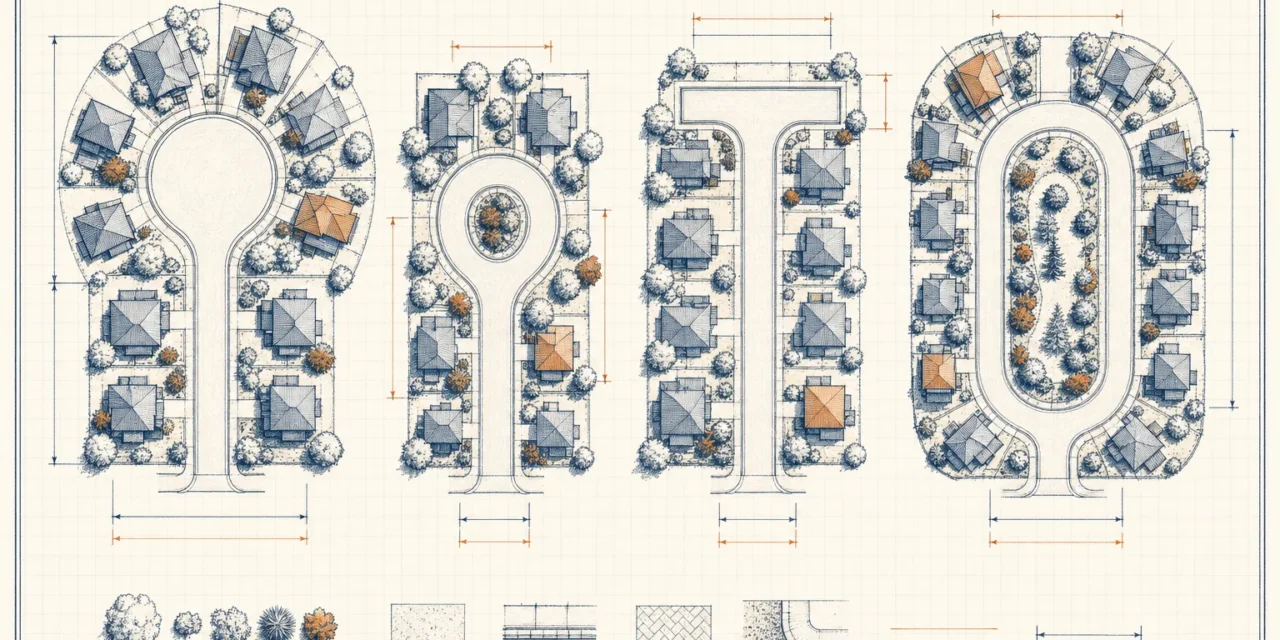
End-of-street turnarounds exist for one reason: vehicles that drive into a closed street need a way to get back out without backing the length of the block. The traditional answer is the cul-de-sac — a wide paved bulb at the dead end. The trouble is that the bulb is one of the largest single pieces of impervious cover in a typical subdivision, and it generates stormwater runoff out of all proportion to the handful of homes it serves. A range of alternative turnarounds — smaller radii, landscaped center islands, loop roads and T-shaped hammerheads — deliver the same vehicle access with a fraction of the pavement. This guide covers the terminology first (cul-de-sac, court, place, circle, dead end), then the four turnaround options with dimensions, the stormwater math, fire-access requirements, and the local-code path to getting alternatives approved.
What Is a Cul-de-Sac?
A cul-de-sac is a local-access residential street with one open end and one closed end, where the closed end is built as a circular paved area that lets a vehicle turn around in a single continuous motion. The name is French — literally “bottom of the bag” — and entered English road planning in the early twentieth century as a polite alternative to “dead end.” In current US subdivision practice the word describes the bulb-and-stem geometry specifically, not just any street that stops.
The defining feature is the turning bulb. Many cul-de-sacs are built with a paved radius of more than 40 feet, which is generous enough for the largest service vehicles to swing around without reversing. That radius is also what makes the cul-de-sac a stormwater concern: a 40-foot-radius circle of asphalt is roughly 5,000 square feet of impervious surface added at the end of a street that may front only six or eight lots. Phrases such as cul-de-sac road and cul-de-sac street refer to the same thing — the closed local street as a whole, including its access stem and the terminal bulb.
Cul-de-Sac vs Court: Is There a Difference?
For most purposes a court and a cul-de-sac are the same physical thing. “Court” (abbreviated Ct on a street sign or in an address) is a street-suffix naming convention that municipalities apply to short, closed residential streets — very often the exact bulb-and-stem layout that planners call a cul-de-sac. The difference is one of vocabulary, not engineering: cul-de-sac is a design term that describes the turnaround geometry, while court, place, circle and similar suffixes are address-naming labels chosen by the developer or the local addressing authority.
Because the suffix is a naming choice, usage varies from one jurisdiction to the next. A street signed as a “Court” is usually a cul-de-sac, but not every cul-de-sac is named “Court” — many are signed “Place,” “Circle,” “Close” or simply “Lane.” The table below summarizes how the common terms are typically used.
| Term | What it describes | Typical use |
|---|---|---|
| Cul-de-sac | Design term: a closed street ending in a turnaround bulb | Planning and engineering documents; describes geometry |
| Court (Ct) | Address suffix for a short closed street, usually with a turnaround | Street signs and addresses; usually a cul-de-sac |
| Place (Pl) | Address suffix often used for short or closed streets | Naming convention; sometimes a cul-de-sac |
| Circle (Cir) | Address suffix implying a curved or looping alignment | Loop roads and bulb turnarounds alike |
| Dead end | Any street closed at one end, with or without a turnaround | Generic description; not always a cul-de-sac |
| Turnaround | The paved area itself that lets a vehicle reverse direction | The component, not the whole street |
Cul-de-Sac vs Dead End (and Close, Circle, Loop)
A dead end is the broad category: any street that is closed to through traffic at one end. A cul-de-sac is a specific kind of dead end — one finished with a built turnaround so vehicles do not have to reverse out. A street barricaded or simply stopped with no turnaround is a dead end but not a cul-de-sac, and it forces drivers (including refuse and emergency vehicles) to back up.
A few related layouts come up in the same conversation. A close is a British term for a short closed street, generally synonymous with a cul-de-sac. A circle may be a bulb turnaround or a small one-way loop, depending on local naming. A loop road is different in kind: it has two connections to the street network and carries traffic in a continuous circuit, so it needs no terminal turnaround at all. That distinction matters for stormwater, because a loop eliminates the bulb entirely — the single largest piece of turnaround pavement.
Why Cul-de-Sacs Are a Stormwater Problem
From a stormwater perspective the cul-de-sac creates a large bulb of impervious cover concentrated at the end of a street, which increases the volume and rate of runoff leaving the site. Pavement does not infiltrate rainfall; nearly all of it runs off. A turning bulb of 40-foot radius adds on the order of 5,000 square feet of new impervious surface to serve only the few lots at the end of the lane, which is a poor ratio of pavement to dwellings.
Reducing the size of cul-de-sacs through alternative turnarounds — or eliminating them altogether with a loop — cuts the impervious cover created at the source. That is the most reliable form of stormwater control, because runoff that is never generated needs no pipe, pond or filter downstream. Combined with companion techniques — narrower street widths, permeable paving for driveways and walkways, and green parking-lot design — the total reduction in site impervious cover can be dramatic, and much of the runoff that remains can be treated on site. The link between impervious cover and watershed health is developed further in the impervious cover model.
Alternative Turnarounds: The Four Options
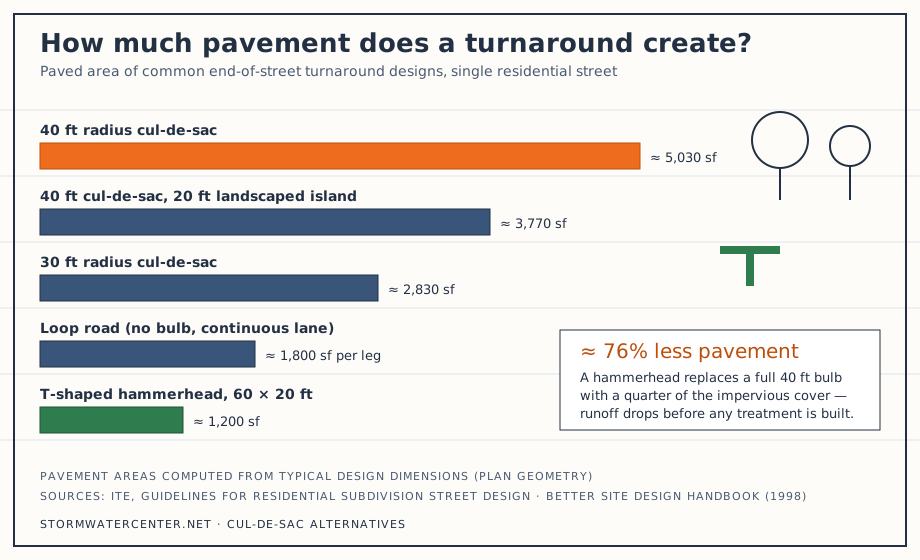
There are numerous alternatives to the traditional 40-foot cul-de-sac that create less impervious cover. The principal options are reducing the cul-de-sac radius to about 30 feet, building hammerheads (T-shaped backing maneuvers), using loop roads, and creating pervious or landscaped islands in the center of the bulb. In a comparison of several different turnaround designs, hammerheads were found to create the least amount of impervious cover. The chart below summarizes the total paved area for each option computed from typical design dimensions.
| Turnaround option | Key dimension | Approx. paved area | Notes |
|---|---|---|---|
| 40 ft radius cul-de-sac | r = 40 ft bulb | ≈ 5,030 sf | Traditional design; largest impervious footprint |
| 40 ft cul-de-sac with landscaped island | 20 ft center island | ≈ 3,770 sf | Pervious or bioretention island removes pavement from the middle |
| 30 ft radius cul-de-sac | r = 30 ft bulb | ≈ 2,830 sf | Reduced radius; still accommodates most service vehicles |
| Loop road | continuous lane | ≈ 1,800 sf per leg | No bulb at all; two connections to the network |
| T-shaped hammerhead | 60 × 20 ft | ≈ 1,200 sf | Least impervious cover of the options compared |
Reduced-radius cul-de-sac
Shrinking the bulb from a 40-foot to a 30-foot radius cuts the circular pavement from roughly 5,030 to 2,830 square feet — close to a 44 percent reduction — while still providing enough room for passenger vehicles and most service trucks to turn. It is the smallest change to a conventional plan and is often the first alternative a reviewing community will accept.
Landscaped or bioretention center island
Keeping the outer driving radius but placing a 20-foot landscaped island in the center removes the unused middle of the bulb from the pavement count, dropping the paved area to about 3,770 square feet. If the island is graded and planted as a bioretention area, it does double duty: it reduces impervious cover and treats the runoff from the surrounding pavement. Island areas that are kept as natural planting cost little to maintain; bioretention islands carry the maintenance of any planted treatment practice.
Loop road
A loop road avoids the turnaround question entirely. Because it connects to the street network at both ends, vehicles drive through rather than reversing, so no terminal bulb is built. The trade-off is that a loop only suits certain site layouts — it needs two viable connection points — but where it fits, it removes the most pavement of any option short of through-streets.
Hammerhead (T-turnaround)
A hammerhead replaces the round bulb with a T or Y of pavement: the driver pulls into the short stub, reverses, and drives back out forward. Because it is built only where the wheels actually travel, it produces the least impervious cover of the options compared — on the order of 1,200 square feet for a 60-by-20-foot T, roughly three-quarters less pavement than a 40-foot cul-de-sac. Its dimensions and fire-access considerations are covered next.
Hammerhead Turnarounds: Dimensions and Design
A hammerhead turnaround is a T- or Y-shaped paved area at the end of a street that lets a vehicle reverse direction with a single backing maneuver. The vehicle enters the stem, backs into one arm of the T, then pulls out forward in the opposite direction. Because it paves only the travel path rather than a full circle, the hammerhead is consistently the lowest-impervious option in turnaround comparisons.
Typical design dimensions cluster around a 60-foot total width across the head with arms about 20 feet deep, sized so a fire apparatus or moving truck can complete the back-and-fill without striking a curb. Many fire codes specify a minimum hammerhead geometry — commonly a 60-foot-long by 20-foot-wide T or an equivalent Y — for the streets they serve, so the exact figures should always be checked against the local fire code and subdivision standard. The table gives representative values.
| Element | Representative dimension | Purpose |
|---|---|---|
| Head width (across the T) | ≈ 60 ft | Length of the backing arm for large vehicles |
| Arm depth | ≈ 20 ft | Clearance for the back-and-fill maneuver |
| Stem (access lane) width | matches street, often 20–24 ft | Approach to the turnaround |
| Approx. total paved area | ≈ 1,200 sf | Least impervious cover of the common options |
Hammerhead driveway
The same geometry scales down to a single property. A hammerhead driveway is a small T or Y added to a long or constrained driveway so a vehicle can turn and leave forward rather than backing into the street — useful on busy roads, steep approaches and lots where a full turning circle would not fit. The principle is identical to the street version: pave only the backing path, not a full circle, to keep the added impervious cover small.
Fire Access and Local Code Requirements
Sufficient turnaround area is a significant factor in cul-de-sac design, and the types of vehicles that will enter the street should be considered explicitly. Fire trucks, service vehicles and school buses are the examples most often cited to justify large turning radii. Closer examination softens that argument: research shows that some fire apparatus is designed for smaller turning radii than the largest bulb assumes; many newer large service vehicles use a tri-axle configuration that turns more tightly; and school buses generally do not enter individual cul-de-sacs at all, picking up at corners instead.
That said, fire access is a genuine constraint, not a formality. Fire-truck turnaround requirements are set by the local fire code and typically specify either a minimum turning radius for a circular turnaround or a minimum hammerhead geometry, along with a maximum dead-end street length beyond which a turnaround becomes mandatory. The right design satisfies those minimums with the least pavement — often a reduced-radius bulb or a code-compliant hammerhead rather than an oversized 40-foot circle. Because the requirements are local, the apparatus dimensions and the accepted turnaround forms should be confirmed with the authority having jurisdiction at the start of design.
The fastest way to lose the impervious-cover argument is to design the turnaround before talking to the fire marshal. Get the local apparatus turning template and the accepted hammerhead dimensions first; then the smallest compliant turnaround is a straightforward design exercise rather than a negotiation after the plan is drawn.
Changing Local Codes to Allow Alternatives
Local regulations often dictate the required turnaround radius, and some of the alternatives may simply not be permitted by the code as written. Marketing perceptions add a second hurdle: cul-de-sacs are frequently promoted as a desirable address, and while alternative turnarounds can keep much of that end-of-street appeal, broad research on market preference is not well established. Both obstacles are real, but neither is fixed.
Changing local codes is no small effort, yet communities do it regularly through a structured review. A local site-planning roundtable — bringing together planners, engineers, fire officials, public works and developers — can examine the existing subdivision standards and recommend revisions that permit reduced radii, hammerheads, landscaped islands and loop roads. The changes are then adopted through a cluster or open-space ordinance or through a collective update of the local street standards. The same roundtable process is the practical vehicle for the related reforms in street-width standards and parking-lot design, and it is the mechanism described throughout the better site design material.
Stormwater Math: From Pavement Area to Runoff
The reason turnaround choice matters downstream is that impervious area converts directly into runoff volume. The Simple Method estimates the runoff coefficient of a surface from its imperviousness as Rv = 0.05 + 0.009·I, where I is the percent impervious cover. Pavement is essentially 100 percent impervious, so its runoff coefficient is about 0.95 — nearly all the rain that lands on it leaves as runoff.
These figures are illustrative of a single turnaround; across a subdivision with many closed streets the avoided runoff adds up quickly. To turn pavement areas into annual runoff and pollutant-load estimates for a specific site and rainfall depth, use the Simple Method runoff calculator, which applies the same Rv relationship to the catchment’s impervious cover.
Pros and Cons of Cul-de-Sacs
Cul-de-sacs persist because they offer genuine advantages to the households on them: low traffic volume, no through-traffic, a quiet shared end-of-street space, and a market reputation as a safe place for children to play. Those qualities are why the layout is so common and why buyers often pay a premium for a cul-de-sac lot.
The costs fall on the wider system. Cul-de-sacs reduce street connectivity, which lengthens trips and concentrates traffic onto fewer collector roads; they complicate transit, walking and emergency routing; and, central to the stormwater concern, the turning bulb generates a large volume of runoff per dwelling served. The alternative turnarounds keep most of the end-of-street character — the quiet, low-traffic feel — while trimming the pavement that drives the runoff and the long-term maintenance cost.
Costs and Maintenance
Because alternative turnarounds reduce the amount of impervious cover created, construction savings can be a direct incentive: asphalt costs roughly $0.50 to $1.00 per square foot in materials alone, so removing 3,000 to 3,800 square feet of pavement at a single turnaround is a measurable saving before any downstream stormwater costs are counted. Bioretention, used for a treatment island, is estimated at about $6.40 per cubic foot; it costs more than a simply vegetated area but can lower overall stormwater management costs by treating runoff in place.
Maintenance follows the same logic. Options with less asphalt mean less surface to repave over the life of the street, and routine maintenance costs less. Where islands are built into a turnaround they do need upkeep: kept as a natural planted area the cost is minimal, while a bioretention island carries the inspection and replanting obligations of any treatment practice. The net position for most projects is lower construction cost, lower repaving cost, and a modest planted-area maintenance line where an island is used.
Count the pavement savings at the subdivision scale, not the single street. One reduced bulb saves a few thousand dollars in asphalt; a standard that applies reduced radii or hammerheads to every closed street in a development compounds the saving across construction, repaving and the size of the downstream stormwater facilities all at once.
References
- American Society of Civil Engineers, National Association of Home Builders, and Urban Land Institute. Residential Streets (2nd edition). Urban Land Institute, Washington, DC. 1990.
- Center for Watershed Protection. Better Site Design: A Handbook for Changing Development Rules in Your Community. Ellicott City, MD. 1998.
- Bucks County Planning Commission. Performance Streets: A Concept and Model Standards for Residential Streets. Doylestown, PA. 1980.
- Institute of Transportation Engineers. Guidelines for Residential Subdivision Street Design. Washington, DC. 1993.
Reference this guide
Frequently asked questions
What is a cul-de-sac?
A cul-de-sac is a local-access residential street with one closed end built as a circular paved bulb that lets a vehicle turn around in a single motion. The name is French for “bottom of the bag.” Many cul-de-sac bulbs have a radius of more than 40 feet, which is what makes them a notable source of impervious cover.
Is a court and a cul-de-sac the same thing?
Usually, yes. “Court” is an address-naming suffix that municipalities apply to short closed streets, which are very often the bulb-and-stem layout that planners call a cul-de-sac. The difference is vocabulary: cul-de-sac describes the geometry, court is a naming label.
Is a court a cul-de-sac?
A street signed “Court” is usually a cul-de-sac, but the suffix is a local naming choice rather than an engineering definition. Some streets named “Court” are short through-streets, and many cul-de-sacs are signed “Place,” “Circle” or “Close” instead.
Why is a street called a court?
“Court” is one of the street-suffix conventions used by developers and local addressing authorities for short, enclosed residential streets, evoking a small shared space at the end of the road. The choice is a naming convention, set jurisdiction by jurisdiction, not a design standard.
What does “Ct” mean on a street sign?
“Ct” is the standard abbreviation for “Court” on street signs and in addresses. It marks a short closed residential street, typically one ending in a turnaround.
What does “Ct” mean in an address?
In a mailing address, “Ct” abbreviates the street suffix “Court.” It identifies the street type and, like all suffixes, is assigned by the local addressing authority when the street is platted.
What is the difference between a court and a circle?
Both are address suffixes. “Court” (Ct) is typically used for a short closed street ending in a turnaround, while “Circle” (Cir) implies a curved or looping alignment — it may be a bulb turnaround or a small one-way loop. Because both are naming conventions, local usage varies.
What does cul-de-sac mean?
Cul-de-sac is French for “bottom of the bag.” In road planning it means a street that is closed at one end and finished with a turnaround so vehicles can reverse direction without backing out.
Why is it called a cul-de-sac?
The term comes from French and translates literally as “bottom of the bag,” describing a passage closed at one end. It was adopted into English road planning as a more refined-sounding alternative to “dead end.”
What is a cul-de-sac house?
A cul-de-sac house is a home on a lot fronting the closed end of a cul-de-sac street. Such lots are often marketed for their low traffic and quiet shared frontage, and buyers frequently pay a premium for them.
What is the difference between a cul-de-sac and a dead end?
A dead end is any street closed at one end. A cul-de-sac is a dead end that has been finished with a built turnaround, so vehicles do not have to reverse out. A plain dead end with no turnaround forces drivers, including service and emergency vehicles, to back up.
What are the standard dimensions of a cul-de-sac?
Traditional cul-de-sac bulbs are built with a paved radius of more than 40 feet, producing about 5,000 square feet of pavement. Reduced designs use a roughly 30-foot radius (about 2,830 square feet). The governing radius is set by the local subdivision and fire codes, so it should be confirmed with the reviewing authority.
What is a hammerhead turnaround?
A hammerhead is a T- or Y-shaped paved area at the end of a street. A driver enters the stem, backs into one arm, and pulls out forward. Because it paves only the travel path rather than a full circle, it creates the least impervious cover of the common turnaround options.
What are the dimensions of a hammerhead turnaround?
Representative hammerhead dimensions are about 60 feet across the head with arms roughly 20 feet deep, sized for a fire apparatus to complete the back-and-fill maneuver. The exact minimum is set by the local fire code and should be verified before design.
Can a fire truck turn around in a hammerhead?
Yes, when the hammerhead is sized to the local fire code. Many codes accept a hammerhead of roughly 60 by 20 feet as an alternative to a circular turnaround. Some fire apparatus is designed for smaller turning radii than the largest bulb assumes, which is why a code-compliant hammerhead is usually adequate. Confirm the required geometry with the authority having jurisdiction.
How much impervious cover does a cul-de-sac create?
A 40-foot-radius bulb is roughly 5,030 square feet of pavement (from πr²), added to serve only the lots at the end of the street. A 30-foot radius drops that to about 2,830 square feet, and a hammerhead to about 1,200 square feet — roughly three-quarters less than the 40-foot bulb.
How do you abbreviate “Circle” in an address?
“Circle” is abbreviated “Cir” in addresses and on street signs. Like “Ct” for Court, it is a street-suffix abbreviation assigned by the local addressing authority.
Are homes on cul-de-sacs worth more?
Cul-de-sac lots are often marketed at a premium for their low traffic and quiet shared frontage, and buyers frequently value those qualities. Broad research on actual market preference is not well established, but the end-of-street appeal is a recognized selling point — one that alternative turnarounds can largely preserve while reducing pavement.