stormwatercenter.net · printed Oct 11, 2026
Stormwater Pond Design Calculator
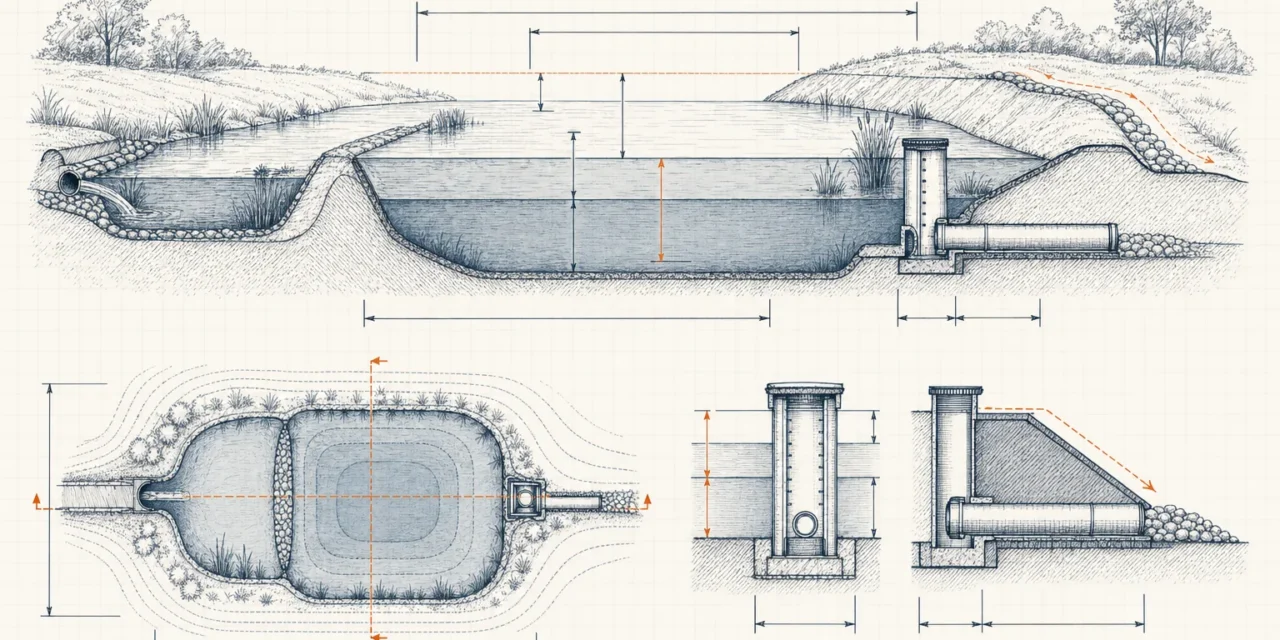
Stormwater pond design turns a graded hole in the ground into a treatment and flood-control facility that a reviewer will approve and a crew can maintain for fifty years. The calculator above runs the standard sizing sequence — water quality volume, channel protection, overbank and extreme flood storage, then outlet hydraulics — and the guide below explains the criteria behind it, ending with a fully worked example for a 38-acre site. For practice-level background, see the wet pond fact sheet and the dry extended detention pond fact sheet.
How a stormwater pond works
A stormwater pond intercepts runoff from a developed drainage area, holds it long enough for treatment and controlled release, and passes extreme events safely over an emergency spillway. Two mechanisms do the work. Gravity: suspended sediment, and the nutrients and metals attached to it, settle out while water sits in the pool. And biology: algae and rooted aquatic plants take up dissolved nutrients during the long residence time of a permanent pool. Median monitored performance for the pond group runs about 80% removal of total suspended solids and roughly half of total phosphorus — figures by practice group and pollutant are in the pollutant removal database.
Above the treatment storage, the same basin doubles as a hydraulic brake: small orifices stretch the release of channel-forming storms over a day or more, and a riser slot plus barrel throttle the 10-year peak back to its pre-development rate. One excavation, one outlet structure — four or five design storms, stacked vertically.
Types of stormwater ponds
Most state manuals recognize five pond variants, all sharing the same sizing framework but distributing the water quality storage differently:
| Variant | Where the WQv lives | Typical use |
|---|---|---|
| Wet pond | Entirely in the permanent pool | Larger drainage areas with reliable baseflow |
| Wet extended detention (ED) pond | About half in the pool, half as ED above it | The workhorse design — smaller pool, better channel protection |
| Micropool ED pond | Mostly ED, small micropool at the outlet | Sites where a large pool is infeasible; keeps the orifice wet |
| Multiple pond system | Split across cells in series | Redundant treatment, long flow paths |
| Pocket pond | Pool sustained by high groundwater | Very small drainage areas with little baseflow |
Feasibility screens come before any variant choice: ponds generally need ten or more contributing acres (25+ preferred) to sustain a permanent pool, should not sit in jurisdictional wetlands, and may require a liner in karst, gravelly sands or fractured bedrock. The BMP selector runs those screens across fifteen other practices if a pond turns out to be the wrong tool.
Retention pond vs detention pond
The two terms get used interchangeably in everyday speech and mean opposite things on a grading plan. A retention pond — the wet pond of the table above — retains a permanent pool of water between storms. A detention pond detains runoff temporarily and drains completely dry, usually within 24 to 72 hours. The distinction drives everything: treatment performance, maintenance, safety profile, even mosquito ecology.
| Attribute | Retention (wet) pond | Detention (dry) pond |
|---|---|---|
| Standing water between storms | Yes — permanent pool | No — drains empty |
| Primary job | Water quality treatment + peak control | Peak flow control |
| Water quality credit | Full WQv treatment | Usually none without a permanent pool |
| Pollutant removal (TSS median) | ~80% | Low; resuspension between storms |
| Baseflow / drainage area need | 10–25+ ac to sustain the pool | Works on smaller areas |
| Maintenance character | Forebay dredging cycles, vegetation | Frequent: clogging, bare soil, mowing |
| Safety consideration | Open deep water — benches required | Lower drowning risk when empty |
| Habitat / amenity value | Moderate to high | Low |
The sizing framework: WQv, Cpv, Qp and Qf
Modern manuals size ponds against a stack of unified criteria rather than a single design storm. Each volume occupies its own band of stage in the pond, each gets its own outlet, and the full derivations live in the sizing criteria guide:
- Recharge volume (REv) — the fraction of runoff returned to groundwater, keyed to soil group. Ponds seal over time and rarely earn this credit, so REv is usually met upstream in an infiltration or bioretention facility.
- Water quality volume (WQv) — storage to capture and treat the runoff from the 90% rainfall event, computed as P · Rv · A / 12 with Rv = 0.05 + 0.009·I, where I is percent impervious cover. The Simple Method calculator works with the same Rv logic for load estimates.
- Channel protection volume (Cpv) — 24-hour extended detention of the post-development 1-year storm, sized to keep downstream channels from enlarging.
- Overbank flood control (Qp) — attenuation of the 10-year (in some states the 2- and 10-year) post-development peak to pre-development rates.
- Extreme flood (Qf) — safe passage of the 100-year event with freeboard, usually over an emergency spillway rather than in dedicated storage.
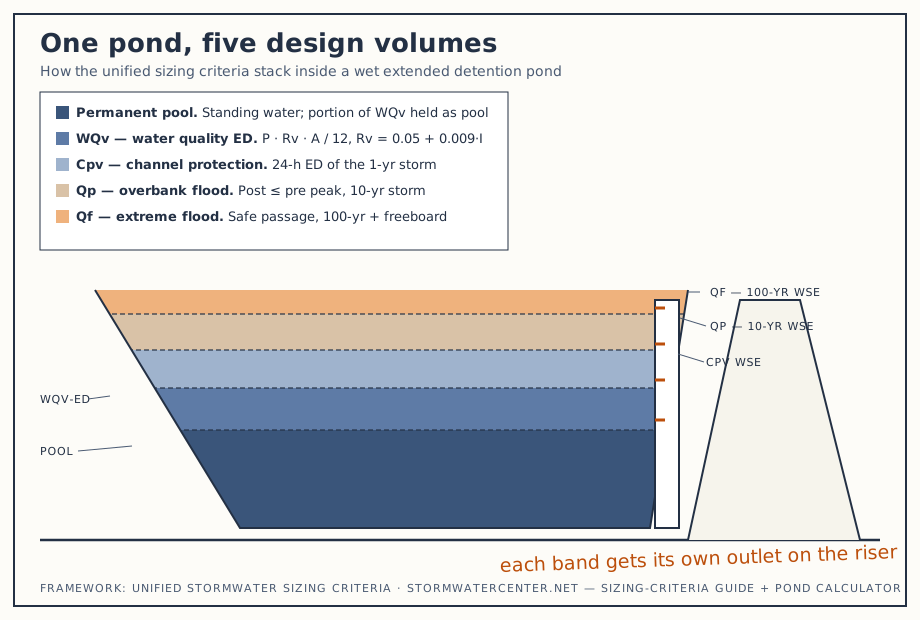
The practical consequence of the stack: the pond is designed from the bottom up — permanent pool first, then the elevations where WQv-ED, Cpv and the 10-year pool are satisfied, and only then the spillway crest and embankment top. The elevation-storage table generated from the grading plan is the spine of the computation, which is exactly how the calculator on this page is organized.
Geometry and grading rules
Sizing tells you how much storage; geometry decides whether the storage actually treats anything. The recurring criteria in state manuals:
- Sediment forebay at each inlet. A separate cell sized to hold 0.1 inches per impervious acre of contributing drainage, 4 to 6 feet deep, with non-erosive exit velocities and direct equipment access. Forebay storage counts toward WQv. This is where the coarse sediment load is meant to drop out — and where almost all routine dredging happens.
- Length-to-width ratio of at least 1.5:1. Long, irregular flow paths discourage short-circuiting from inlet to riser. Baffles, islands and multiple cells all buy effective length.
- Benches around deep water. Wherever the pool is four feet or deeper: a safety bench extending 15 feet outward from the normal pool edge at no more than 6% slope, and an aquatic bench extending up to 15 feet inward at a maximum depth of 18 inches. One keeps people out of deep water; the other grows the emergent vegetation that does the nutrient work.
- Side slopes gentle enough to mow and exit — commonly 3:1 or flatter on the interior.
- Pond buffer of 25 feet from the maximum water surface, with no woody vegetation within 15 feet of the embankment toe or 25 feet of the principal spillway — roots and burrows are how embankments fail.
Outlet design
The outlet structure — typically a concrete riser with a barrel through the embankment — is the control panel for the volume stack. From bottom to top a wet ED riser carries: a pond drain with gate valve, a small WQv-ED orifice just above the permanent pool, a Cpv-ED orifice at the WQv elevation, a wide slot for the 10-year release, and the barrel itself. Two equations do most of the work:
Small orifices clog — standard defenses are a removable trash rack, a reverse-sloped pipe drawing below the pool surface, or an orifice plate protected inside the riser. Every pond also needs a drain able to dewater the pool for dredging, with a valve operable without entering the structure.
Embankment and hazard classification
The embankment is a small dam, and dam-safety review usually applies. Early in design the designer screens the downstream consequences of a hypothetical breach; a common screening relation for the breach peak is Qmax = 3.2 Hw5/2, with Hw the water depth at the dam at failure. If the breach flow passes the downstream road and reaches no structures, the pond classifies as low hazard and ordinary spillway standards apply; anything worse triggers stricter spillway storms and geotechnical requirements. The classification is confirmed once embankment height is final. Earthwork follows the construction specifications.
Worked example: a wet ED pond for a 38-acre site
The sequence below condenses the classic design example that the calculator reproduces. Site data: 38.0 acres draining to the pond; existing ground at the outlet 320.0 ft; seasonally high water table at 318.0 ft; SC (sandy clay) soils suitable for an embankment and an unlined pool; adjacent stream invert at 316.0 ft. Required volumes, precomputed under the sizing criteria: REv 0.24 ac-ft, WQv 1.08 ac-ft, Cpv 1.65 ac-ft, preliminary Qp10 2.83 ac-ft, plus safe passage of the 100-year flood with one foot of freeboard.
The 15% bump in Step 2 is the difference between a pond that routes and a pond that gets redesigned after the TR-20 run. Short-cut storage methods assume one outlet doing one job; the moment WQv-ED and Cpv-ED orifices are bleeding flow below the 10-year stage, the simple estimate runs short.
Landscaping and safety
Ponds attract people, which is why the design criteria read like playground rules. The bench pair around deep water is the primary measure — a flat 15-foot shelf before the drop, and a planted shallow shelf in the water. Fencing is generally discouraged in favor of gentle slopes and dense fringe vegetation; a fence keeps maintenance crews out more reliably than children. The 25-foot buffer doubles as goose management when planted in trees, shrubs and tall native cover rather than mowed turf, and buffer plantings need oversized holes backfilled with uncompacted topsoil to survive the construction-compacted soils.
Maintenance
A pond that cannot be maintained was never designed, and most manuals make the paperwork part of the design: a legally binding maintenance agreement, a recorded easement with equipment access to the forebay and riser, and a sediment disposal plan. The operational rhythm is inspection after major storms and at least annually, mowing of the embankment and access ways, cleaning the trash rack, and dredging the forebay when the sediment marker says capacity is half gone. Because the forebay concentrates deposition into one small cell, full-pond dredging becomes a rare event. The framework — agreements, easements, inspection checklists — is covered in the maintenance guide and the easement model language.
What a stormwater pond costs
The most widely cited construction-cost relation for ponds is C = 24.5 V0.705 (Brown and Schueler, 1997), with V the 10-year storage volume in cubic feet — covering construction, design and permitting. Adjusted for inflation, that puts a 1 ac-ft facility around $45,700 and a 10 ac-ft facility around $232,000: strong economy of scale. Two costs sit outside the equation — land (a pond typically consumes 2–3% of its contributing drainage area) and upkeep (annual maintenance at an estimated 3–5% of construction cost). On the asset side, properties adjacent to well-landscaped wet ponds have shown value premiums of 10% or more (US EPA, 1995).
Cost equations age, but the exponent is the durable part: doubling the storage volume raises cost by about 63%, not 100%. One regional pond is almost always cheaper than four parcel ponds — the argument for drainage-area consolidation writes itself.
Frequently asked questions
How does a stormwater pond work?
Runoff enters through a sediment forebay where coarse particles drop out, then spends hours to days in the main pool where finer sediment settles and aquatic vegetation takes up nutrients. Outflow leaves through a multi-stage riser that releases small storms slowly and throttles large storms back to pre-development peak rates, with a spillway passing extreme events safely.
What is the difference between a retention pond and a detention pond?
A retention pond keeps a permanent pool of water between storms and provides water quality treatment; a detention pond drains completely dry and mainly controls peak flows. Hybrid designs — wet extended detention ponds — hold a pool for treatment and stack temporary detention storage above it.
What is a retention pond?
A retention pond, also called a wet pond, is a constructed basin that maintains a standing pool of water year-round. Incoming stormwater displaces and mixes with the pool, allowing sediment to settle and plants and algae to remove nutrients before water exits through the outlet structure. Details are in the wet pond fact sheet.
What is a detention pond?
A detention pond is a basin that temporarily stores runoff during a storm and releases it over hours through a fixed outlet, emptying completely afterward. It reduces flooding and peak flows but provides little water quality treatment unless a permanent pool or other treatment element is added.
What is the purpose of a retention pond?
Three purposes in one basin: remove pollutants from runoff through settling and biological uptake, protect downstream channels by releasing the channel-forming storms slowly, and attenuate flood peaks from larger storms to pre-development levels.
How deep is a stormwater pond?
Permanent pools typically run 3 to 8 feet deep — deep enough to prevent resuspension and algae-choking sunlight penetration of the full water column, shallow enough to avoid stratification. Above the pool, several more feet of temporary storage stage up during storms, so total basin depth from bottom to embankment top often reaches 10 to 14 feet.
How deep is a retention pond at the edge?
Properly designed edges are intentionally shallow: an aquatic bench extends up to 15 feet into the pond at no more than 18 inches deep before the bottom drops toward the main pool.
How do retention ponds work in heavy rain?
The pool level rises into the extended detention and flood storage bands, each band draining through its own outlet — small orifices for the treatment and channel-protection volumes, a weir slot for the 10-year storm. If inflow exceeds the riser’s capacity, the emergency spillway engages and passes the excess as designed, with freeboard protecting the embankment.
How is the required size of a stormwater pond determined?
From the stacked sizing criteria: water quality volume (P·Rv·A/12), channel protection volume (24-hour detention of the 1-year storm), overbank flood storage for the 10-year storm, and safe passage of the 100-year event. Each volume is matched to an elevation using the pond’s elevation-storage table, which is exactly the sequence the calculator on this page automates.
What is the water quality volume (WQv)?
WQv is the storage required to capture and treat the runoff from roughly the 90th-percentile rainfall event. It is computed as P·Rv·A/12, where P is the design rainfall depth, A the drainage area, and Rv = 0.05 + 0.009·I the volumetric runoff coefficient driven by impervious cover. The sizing criteria guide derives it step by step.
What is a sediment forebay and why is it required?
A forebay is a separate small cell at each pond inlet, sized for about 0.1 inches of runoff per impervious acre and 4 to 6 feet deep. It traps coarse sediment in one accessible, often hardened, location so the main pool keeps its treatment volume and dredging stays cheap. Most manuals require one at every inlet carrying 10% or more of the design inflow.
How do you build a retention pond?
After design approval: clear and strip the footprint, excavate the pool and forebay, construct the embankment in compacted lifts around the barrel with seepage controls, set the riser, grade the benches and side slopes, install the trash rack and pond drain, then stabilize and plant per the landscaping plan. Earthwork and material standards follow the construction specifications.
How much does a stormwater pond cost?
Using the Brown and Schueler (1997) equation C = 24.5 V0.705 adjusted for inflation, roughly $45,700 for a 1 ac-ft facility and about $232,000 at 10 ac-ft, plus land (2–3% of the drainage area) and annual maintenance at 3–5% of construction cost.
How often do stormwater ponds need to be dredged?
The forebay does most of the catching and is typically cleaned when sediment reaches about half its capacity — on busy sites that can be every few years. The main pool, protected by the forebay, commonly goes decades between full dredging events. A fixed sediment depth marker in the forebay takes the guesswork out of the schedule.
Can you swim in a stormwater pond?
No. Stormwater ponds receive untreated urban runoff carrying bacteria, metals and hydrocarbons, the bottom drops off quickly beyond the benches, and outlet structures create suction hazards near the riser. The benches and gentle slopes exist to let someone climb out, not to invite anyone in.
What permits are required to build a stormwater pond?
Typically the local stormwater or land development approval, an erosion and sediment control permit, dam safety review where the embankment meets state height or storage thresholds, and wetlands permits if the work touches jurisdictional waters. The local reviewing authority’s checklist governs.
Which agencies regulate stormwater pond construction?
The local jurisdiction (city or county stormwater program) reviews the design; the state environmental agency administers construction stormwater permits and, through its dam safety office, embankment classification; and the U.S. Army Corps of Engineers gets involved when the pond affects jurisdictional waters. The local review process guide walks through a typical sequence.
Do stormwater ponds breed mosquitoes?
A healthy permanent pool with fish and stable water levels supports mosquito predators and is a poor nursery. The real risk is failed designs — clogged orifices stranding shallow stagnant water for days — so keeping the low-flow outlets clear is the most effective mosquito control available.