stormwatercenter.net · printed Oct 11, 2026
BMP Selector
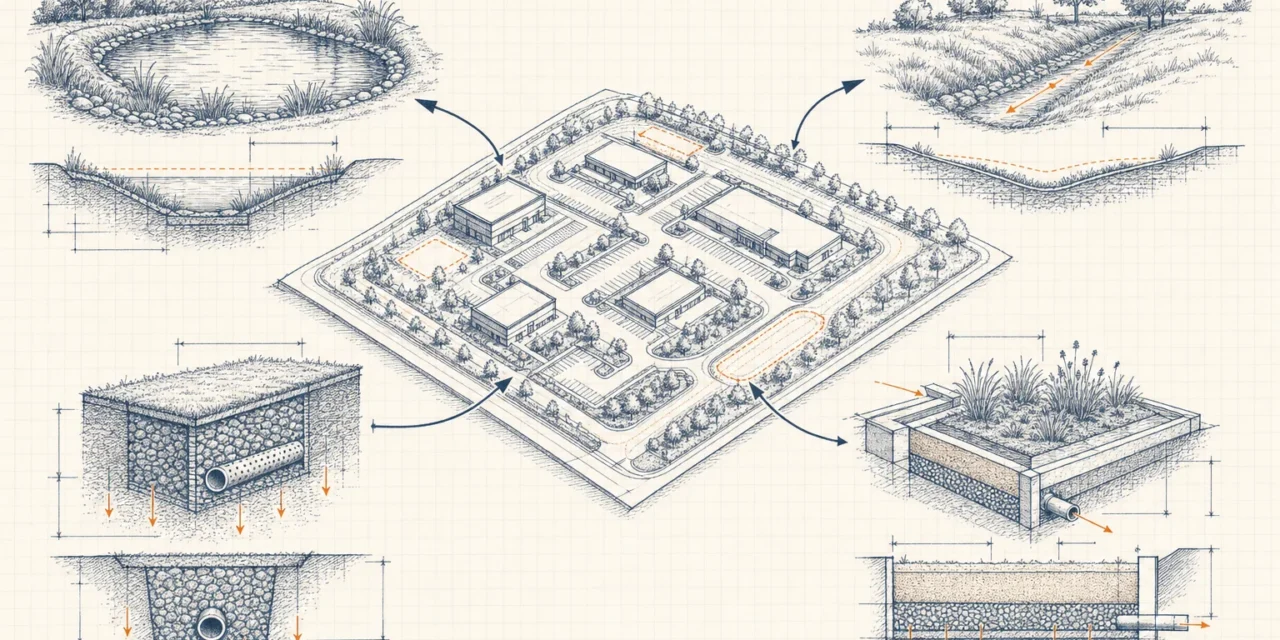
Choosing a stormwater practice is a process of elimination, not inspiration. The selector above screens sixteen practices against the conditions of a specific site — drainage area, soils, head, water table, slope, space and land use — and returns the candidates that survive, each linked to its fact sheet and design calculator. The guide below explains what is being screened and why, so the output reads as an engineering shortlist rather than a black box.
What are stormwater BMPs?
A stormwater BMP — best management practice — is any technique used to reduce the quantity or improve the quality of stormwater runoff. The term covers two distinct families. Structural BMPs are built facilities that capture and treat runoff: ponds, wetlands, infiltration trenches, sand filters, bioretention cells, swales. Non-structural BMPs are practices and behaviors that keep pollutants out of runoff in the first place: street sweeping, pollution prevention at businesses, lawn-care and pet-waste programs, and land-use decisions that limit impervious cover. Many manuals now use “stormwater treatment practice” (STP) or “stormwater control measure” (SCM) for the structural family; this selector deals with the structural practices, since those are the ones a site plan must choose among.
The same abbreviation has a second life on construction sites, where “BMPs” means temporary erosion and sediment controls — silt fence, inlet protection, stabilized entrances. That distinction gets its own section below, because mixing up the two families is one of the most common sources of confusion in plan review.
Types of stormwater BMPs
Structural practices sort into five groups, each with a shared treatment mechanism and a shared set of siting constraints:
- Ponds — basins with a permanent pool (or micropool) that treat by settling and biological uptake: the wet pond and its extended-detention variants. Need large drainage areas; deliver low-maintenance treatment at low unit cost.
- Wetlands — shallow, planted systems such as the stormwater wetland; the highest habitat value, the largest land take.
- Infiltration — the infiltration trench and infiltration basin, which return runoff to groundwater. Demand permeable A/B soils, water-table separation and disciplined pretreatment.
- Filtering systems — the sand filter family and bioretention, which strain runoff through engineered media and collect it in an underdrain. Work on any soil, fit small urban catchments, accept hotspot runoff.
- Open channels — the dry swale, wet swale and grass channel, which treat along the conveyance path.
How the selector screens practices
The selector compresses the classic step-wise screening matrices from regional design manuals into one pass. The underlying logic runs through the same factors a designer would check by hand, in the same order:
The screening output is deliberately a shortlist, not a single answer: most sites have two or three defensible options, and the final call belongs to the designer and the reviewing authority.
BMP selection criteria explained
Five physical thresholds do most of the eliminating in Screen 2:
- Drainage area. Ponds and wetlands need roughly 10–25 acres or more of contributing drainage to sustain a permanent pool or marsh; infiltration and filtering practices cap out near 2–10 acres before flows overwhelm them. Drainage area alone usually cuts the list in half.
- Soils. Infiltration practices require hydrologic soil group A or B (measured rates above about 0.5 in/hr). Practices with underdrains — sand filters, bioretention, dry swales — work on any group. Wet swales actually want the C/D soils everything else avoids.
- Head. The elevation difference available to push water through the practice. Surface sand filters and bioretention typically need about 5 feet; perimeter filters get by on 2; swales and infiltration practices on 1 to 3.
- Water table. Practices that filter or infiltrate need separation — commonly 2 to 4 feet — between the bed bottom and the seasonally high water table; ponds and wetlands can tolerate, or even exploit, groundwater contact.
- Space. Surface footprint as a share of the site: underground filters consume effectively none, swales and bioretention claim linear and landscape space, ponds and especially wetlands take whole site corners.
Feasibility at a glance: sixteen practices
The table below summarizes the thresholds the selector applies — the same values, practice by practice, that drive its output:
| Practice | Group | Drainage area | Soils | Min head | Max slope | Space | High-density site |
|---|---|---|---|---|---|---|---|
| Wet pond | Ponds | ≥ 25 ac | A–D | 6 ft | 15% | Medium | No |
| Wet ED pond | Ponds | ≥ 25 ac | A–D | 6 ft | 15% | Medium | No |
| Micropool ED pond | Ponds | ≥ 10 ac | A–D | 4 ft | 15% | Medium | No |
| Shallow marsh | Wetlands | ≥ 25 ac | A–D | 3 ft | 15% | High | No |
| ED wetland | Wetlands | ≥ 25 ac | A–D | 3 ft | 15% | Medium | No |
| Pond/wetland system | Wetlands | ≥ 25 ac | A–D | 6 ft | 15% | High | No |
| Infiltration trench | Infiltration | ≤ 5 ac | A, B | 1 ft | 15% | Low | Yes |
| Infiltration basin | Infiltration | ≤ 10 ac | A, B | 1 ft | 15% | Medium | No |
| Surface sand filter | Filtering | ≤ 5 ac | A–D | 5 ft | 6% | Low | Yes |
| Underground sand filter | Filtering | ≤ 2 ac | A–D | 5 ft | 6% | Low | Yes |
| Perimeter sand filter | Filtering | ≤ 2 ac | A–D | 2 ft | 6% | Low | Yes |
| Organic filter | Filtering | ≤ 5 ac | A–D | 5 ft | 6% | Low | Yes |
| Bioretention | Filtering | ≤ 5 ac | A–D | 5 ft | 6% | Medium | Yes |
| Dry swale | Open channels | ≤ 5 ac | A–D | 3 ft | 4% | Medium | No |
| Wet swale | Open channels | ≤ 5 ac | C, D | 1 ft | 4% | Medium | No |
| Grass channel | Open channels | ≤ 5 ac | A–D | 1 ft | 4% | Medium | No |
Cost and maintenance comparison
Once feasibility narrows the field, lifecycle realities separate the finalists. The pattern across the groups is remarkably consistent:
| Group | Relative cost | Maintenance burden | Safety | Habitat |
|---|---|---|---|---|
| Ponds | $ – $$ | Low (forebay dredging cycles) | Open-water risk — benches required | Moderate |
| Wetlands | $ – $$ | Moderate (vegetation management) | Shallow — generally safe | High |
| Infiltration | $ – $$ | High (clogging; historic failure rates) | Safe | Low |
| Filtering | $$$ | Moderate–high (media replacement) | Safe | Low–moderate |
| Open channels | $ – $$ | Low (mowing, sediment behind dams) | Safe | Low–moderate |
Two rules of thumb fall out of the table. Filters buy small-footprint, any-soil flexibility with the highest unit costs and the most demanding maintenance. Ponds buy cheap, low-effort treatment with land and drainage-area requirements — for the design consequences, see the pond design calculator.
Verifying performance after selection
Feasibility says a practice fits; it says nothing about how well it treats. Monitored removal efficiency varies widely between groups — and between studies of the same group — which is why a pollutant-driven project (a TMDL watershed, a nutrient-limited lake) should rank its shortlist against observed data rather than design intent:
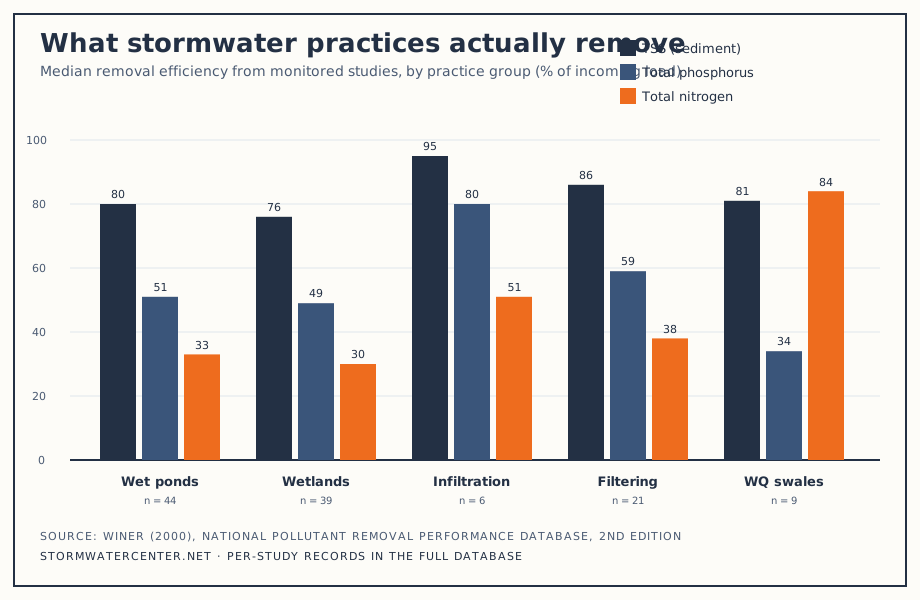
The full study-level evidence behind those medians — including the spread that the medians hide — is in the pollutant removal database. As a shortcut: dry swales and infiltration practices post the highest median removals, ponds and wetlands the most consistent ones, and grass channels the lowest of the structural set.
Selection by setting
Ultra-urban sites. When the entire site is building and pavement, the surviving practices are the ones with no footprint: underground and perimeter sand filters, bioretention in planter form, and infiltration trenches in utility strips. This is the one setting where the expensive filter family wins by default.
Residential developments. Safety and appearance carry formal weight — deep open water argues for wetlands or micropool designs over full wet ponds, and visible practices need a landscaping plan to earn community acceptance. Maintenance falls to an HOA or the municipality, which favors low-burden practices.
Cold climates. Chloride from road salt passes through nearly everything, submerged inlets can freeze, and infiltration is restricted in seasonally frozen ground; designs compensate with deeper sumps, on-line pools and conservative drawdown assumptions.
Sensitive receiving waters. The downstream resource modifies the choice: discharges over aquifers restrict untreated infiltration and demand pretreatment; urban lakes and reservoirs reward the phosphorus removers (large permanent pools); shellfish and swimming waters prioritize bacteria reduction through long detention times; cold-water trout streams penalize big sun-warmed pools and favor shaded, quick-draining practices.
Construction-phase vs post-construction BMPs
“BMP” on an erosion-control plan and “BMP” on a stormwater management plan are different animals. Construction-phase BMPs are temporary measures — silt fence, sediment traps and basins, inlet protection, stabilized construction entrances, seeding and matting — installed to keep soil on site while the ground is open, and removed when vegetation establishes. Post-construction BMPs are the permanent facilities this selector screens, designed to operate for decades after buildout. The two interact in one critical way: a permanent practice that receives construction-phase sediment can be ruined before the project closes out, so infiltration and filtering practices stay offline until their drainage areas are fully stabilized, and sediment basins are converted to permanent ponds only with deliberate cleanout and re-grading.
Common selection mistakes
- Choosing the practice before checking drainage area. The wet pond sketched on the concept plan dies in review when the site delivers eight acres, not twenty-five.
- Assuming soils instead of testing them. Infiltration practices sized on mapped soil groups, without borings and field infiltration tests at the practice location, are the classic failure — historic failure rates for infiltration basins trace mostly to this shortcut.
- Ignoring head until the grading plan. A surface sand filter needs about five feet of fall; flat coastal sites simply do not have it, and discovering that late forces a redesign around a perimeter filter or wet practice.
- One practice asked to do every job. Few practices deliver recharge, water quality, channel protection and flood control alone. Treatment trains — bioretention to an ED pond, a filter to an infiltration trench — are the norm, not the exception.
- Forgetting the maintenance owner. A practice with no named, funded, legally bound maintenance party fails on schedule regardless of design quality.
- Treating screening guidance as law, or law as guidance. Some thresholds are engineering judgment; some are regulatory mandates. Knowing which is which requires the local manual, not a generic matrix.
The selector’s most useful output is often the practice it removes. A shortlist without ponds tells the site engineer to budget for filter media and maintenance contracts before the first grading iteration — that information is worth more in week one than in month six.
How this selector relates to local manuals
The thresholds in this tool are the generic values used in regional design manuals; nearly every jurisdiction adjusts some of them — drainage-area minimums, recharge requirements, cold-climate modifications, accepted practice lists. The selector is a screening instrument for early site planning: use it to build the shortlist and frame the pre-application meeting, then confirm every criterion against the reviewing authority’s published manual, since the local document governs whenever the two disagree. The local review process guide describes how that conversation typically runs, and the sizing criteria guide covers the volume computations every accepted practice must then satisfy — with the dry swale and pond calculators handling the design math for the two most common outcomes.
Frequently asked questions
What are the BMPs in stormwater?
Stormwater BMPs are the practices used to manage runoff quantity and quality. Structural BMPs are built facilities — ponds, wetlands, infiltration practices, sand filters, bioretention and swales. Non-structural BMPs prevent pollution at the source: sweeping, public education, pollution prevention at businesses, and land-use planning.
What does BMP stand for in stormwater?
Best management practice. Newer manuals increasingly say stormwater control measure (SCM) or stormwater treatment practice (STP) for the structural facilities, but BMP remains the most widely used term in permits and ordinances.
What is a stormwater BMP?
Any single practice — structural or otherwise — implemented to reduce runoff volume, attenuate peak flows or remove pollutants before runoff reaches receiving waters. A wet pond, a bioretention cell and a municipal street-sweeping program are all stormwater BMPs.
What are BMPs in construction?
On construction sites, BMPs are the temporary erosion and sediment controls required during land disturbance: silt fence, sediment basins and traps, inlet protection, stabilized entrances, and prompt seeding or matting of bare soil. They protect waterways while the ground is open and are removed after stabilization.
What is the difference between construction and post-construction BMPs?
Construction BMPs are temporary and target sediment from disturbed soil; post-construction BMPs are permanent facilities that treat runoff from the finished development for decades. The selector on this page screens the permanent family.
What is stormwater management?
The combined effort to control runoff from developed land: limiting how much is generated, detaining and treating what does run off, and protecting downstream channels, aquifers and receiving waters. It spans site design, structural practices and source-control programs.
What is a stormwater management plan?
The document submitted with a development application showing how the site meets local stormwater requirements — drainage computations, the selected practices with sizing per the unified criteria, conveyance design, and the maintenance agreement naming a responsible party.
How can the flow of stormwater be controlled?
Three levers in sequence: reduce generation (less impervious cover, disconnection of rooftops), detain and release slowly (ponds, vaults, extended detention), and infiltrate or filter (trenches, basins, bioretention, swales). Most sites combine all three.
What are examples of structural stormwater BMPs?
Wet and extended-detention ponds, stormwater wetlands, infiltration trenches and basins, surface and underground sand filters, organic filters, bioretention cells, dry swales, wet swales and grass channels — the sixteen practices this selector screens, each documented in the fact sheet library.
What are non-structural BMPs?
Programs and behaviors rather than facilities: street and parking-lot sweeping, catch basin cleaning, lawn-care and pet-waste education, spill prevention at businesses, illicit-discharge programs, and planning measures that limit impervious cover. They reduce the load the structural practices must treat.
Which BMP removes the most pollutants?
By monitored medians, dry swales and infiltration practices lead for sediment and nutrients, with filters close behind for sediment and metals. No practice leads in every category — which is why pollutant-specific selection should consult the pollutant removal database rather than a single ranking.
What is the cheapest stormwater BMP?
Among practices with real treatment function, grass channels and wet swales have the lowest construction cost, and ponds deliver the lowest cost per impervious acre treated on larger sites thanks to economy of scale. Filters sit at the expensive end. Lifecycle cost, including maintenance, often reorders the list.
How do soil conditions affect BMP selection?
Hydrologic soil group is a primary screen: A and B soils open the infiltration family; C and D soils close it and point toward underdrained practices (filters, bioretention, dry swales) or wet practices. Measured infiltration rates at the practice depth — not mapped soil units — make the final call.
Can multiple BMPs be combined in a treatment train?
Yes, and most complete designs are trains: pretreatment (forebay, grass channel) feeding a primary practice, sometimes with downstream detention for channel protection and flood control. Trains also add redundancy — when one element underperforms, the next still treats.
What BMPs work on small urban sites?
Underground and perimeter sand filters, bioretention in planters and parking islands, and infiltration trenches where soils allow. These are the practices flagged as high-density-compatible in the feasibility table — small footprints, modest drainage areas, tolerance of tight geometry.
How often do stormwater BMPs need maintenance?
Every practice needs at least annual inspection. Beyond that, the burden ranges from low (ponds: periodic forebay cleanout) through moderate (wetlands, bioretention: vegetation management) to high (filters and infiltration: media and surface renewal on multi-year cycles). The maintenance guide covers schedules and model agreements.
Who approves the BMP choice for a development project?
The local reviewing authority — the city, county or drainage-district stormwater program — applying its adopted design manual, with state agencies involved for construction permits, dam safety and discharges to special waters. Early agreement on the practice list, ideally at a pre-application meeting, prevents most late redesigns.
Do BMPs remove pollution completely?
No. Even the best monitored practices pass a share of every pollutant, and dissolved constituents like chloride pass through almost untouched. That is why manuals pair structural treatment with source control: the load that never enters runoff is the only load removed at 100%.