Pet Waste and Water Quality
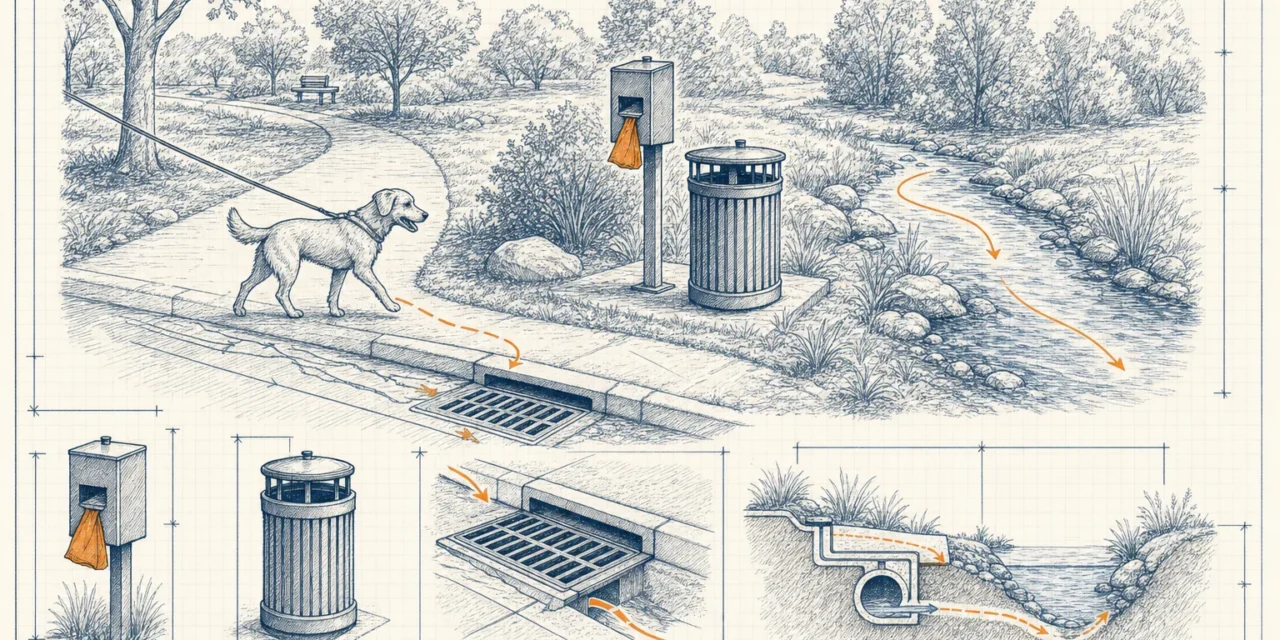
Pet waste is easy to dismiss as a nuisance rather than a pollutant — it is small, it is organic, and it seems like it should simply break down. In a watershed it does not behave that way. Dog waste is a concentrated source of fecal bacteria and nutrients that washes off lawns, sidewalks and trails into storm drains and, untreated, straight into the nearest stream. The pollution is well documented: genetic studies trace much of the fecal bacteria in urban runoff to non-human sources including dogs, and resident surveys show that even where people know the problem exists, a large share still do not clean up. This page lays out the water-quality pathway, the survey and loading numbers that quantify the problem, the practical solutions — pet-waste stations, digesters and disposal options — and the ordinance and outreach approaches that municipalities use to change behavior.
Why Pet Waste Is a Water Pollutant
The presence of pet waste in stormwater runoff has several implications for urban stream water quality, with the greatest impact coming from fecal bacteria. Dog feces also carry nutrients — nitrogen and phosphorus — that fuel weed and algae growth once they reach a lake or pond. It is the combination of pathogens and nutrients, not simple unsightliness, that makes pet waste a recognized nonpoint-source pollutant rather than a fertilizer.
The scale of the bacterial load is the part most people underestimate. A single gram of dog feces can contain about 23 million fecal coliform bacteria (van der Wel, 1995). Dogs are also significant hosts of Giardia and Salmonella (Pitt, 1998). When that material is left on the ground, the next rain carries the bacteria into the storm drain network, where — unlike sanitary sewage — it usually reaches receiving waters without any treatment.
How Pet Waste Reaches Waterways
The pathway is short and direct. Waste left on a lawn, sidewalk, trail or street is picked up by rainfall and snowmelt, carried as runoff across impervious surfaces, and routed into a storm drain. In most urban drainage systems the storm drain discharges to the nearest stream, river or bay with no treatment step in between. That is the crucial difference between pet waste and the waste handled by sanitary sewers: storm drains are designed to move water quickly, not to clean it.
Because the connection is so direct, waste deposited near a buffer, ditch or drainage way is the most damaging — it is hydraulically connected to the stream and reaches it with the next storm. Waste decaying in the open also releases its nutrients into runoff. The release of nutrients from decaying pet waste promotes weed and algae growth in lakes and ponds, which limits light penetration, suppresses aquatic vegetation, and can lower dissolved-oxygen levels enough to affect fish and other aquatic organisms — the process of eutrophication. The same storm-drain-to-stream link is why catch-basin maintenance and broader residential stewardship practices matter for bacterial pollution control.
The Numbers: Pet Waste Pollution Statistics
Several lines of evidence quantify how much pet waste contributes to bacterial pollution. Genetic and bacterial-source-tracking studies by Alderiso et al. (1996) and Trial et al. (1993) both concluded that about 95 percent of the fecal coliform found in urban stormwater was of non-human origin. A bacterial-source-tracking study in a watershed in the Seattle, Washington area found that nearly 20 percent of the bacteria isolates that could be matched with a host animal were matched with dogs. A 1982 study of Baltimore, Maryland catchments found that dog feces were the single greatest contributor of fecal coliform and fecal strep bacteria (Lim and Olivieri, 1982).
The loading can be enough to close a waterbody to recreation. It has been estimated that for watersheds of up to twenty square miles draining to small coastal bays, two to three days of droppings from a population of about 100 dogs would contribute enough bacteria and nutrients to temporarily close a bay to swimming and shellfishing (US EPA, 1993). At a larger scale, in the Four Mile Run watershed in Northern Virginia a dog population of about 11,400 is estimated to contribute roughly 5,000 pounds of solid waste every day and has been identified as a major bacterial contributor; of approximately 500 fecal coliform samples taken from the stream and its tributaries since 1990, about 50 percent exceeded Virginia water quality standards for fecal coliform bacteria (NVPDC, 1998).
| Finding | Figure | Source |
|---|---|---|
| Fecal coliform in 1 gram of dog feces | ≈ 23 million | van der Wel, 1995 |
| Urban-stormwater fecal coliform of non-human origin | ≈ 95% | Alderiso et al., 1996; Trial et al., 1993 |
| Seattle-area host-matched bacteria isolates traced to dogs | ≈ 20% | Trial et al., 1993 |
| Dogs to temporarily close a coastal bay (≤ 20 sq mi) | ≈ 100 dogs, 2–3 days | US EPA, 1993 |
| Four Mile Run dog population / daily solid waste | 11,400 dogs / 5,000 lb/day | NVPDC, 1998 |
| Four Mile Run samples exceeding fecal coliform standard | ≈ 50% of ~500 | NVPDC, 1998 |
Survey Data: What Residents Actually Do
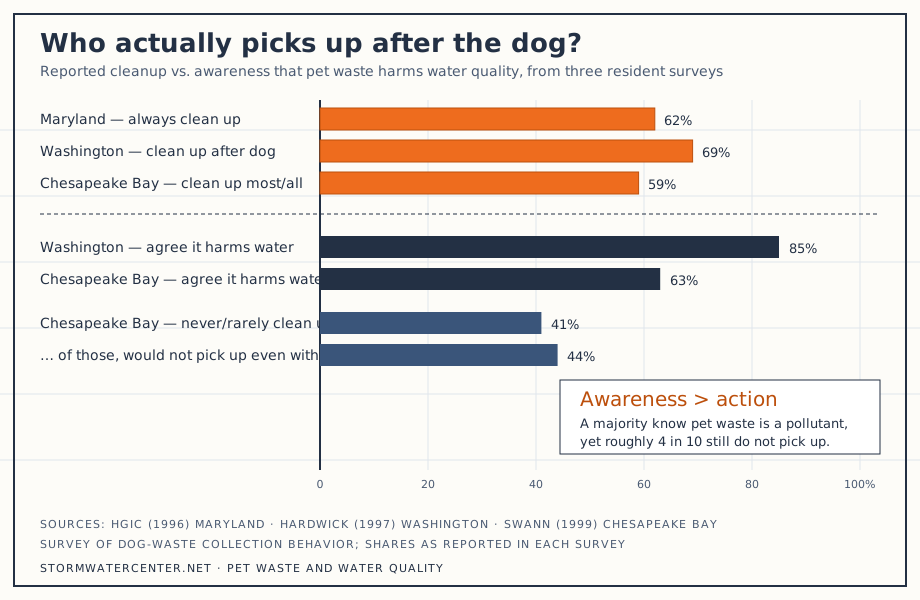
Whether pet waste becomes a pollutant depends on behavior, and several resident surveys have measured that behavior directly. In a survey of Chesapeake Bay residents, about 41 percent of households owned a dog; just under half of those owners actually walked their dog in public areas, and of the dog walkers, about 59 percent cleaned up most or all of the time (Swann, 1999). Men were found to be less likely than women to pick up after their dog. These figures are broadly consistent with other surveys, summarized below.
| Survey | Cleanup behavior | Disposal method |
|---|---|---|
| Maryland (HGIC, 1996) | 62% always cleaned up; 23% sometimes; 15% never | Trash can 66%; toilet 12%; other 22% |
| Washington (Hardwick, 1997) | Pet ownership 58%; 51% of owners do not walk dogs; 69% cleaned up; 31% do not pick up; 85% agreed pet waste contributes to water-quality problems | Trash can 54%; toilet 20%; compost 4%; 4% train pet to use own yard |
| Chesapeake Bay (Swann, 1999) | Dog ownership 41%; 44% of owners do not walk dogs; 59% of walkers clean up most/all of the time; 41% never or rarely clean up; 63% agreed pet waste contributes to water-quality problems | — |
The surveys reveal a consistent split: a strong majority agree that dog waste can be a water-quality problem (Hardwick, 1997; Swann, 1999), yet residents generally rank it as the least important local water-quality problem (Syferd, 1995; MCSR, 1997). That gap between awareness and priority is the central challenge for any pet-waste program — people know, but do not act on what they know.
The reasons owners give for not picking up are revealing, and the reluctance to handle dog waste is the single biggest limitation to controlling it. Recorded rationales (HGIC, 1996) range from “because it eventually goes away” and “too much work” to “it’s on the edge of my property,” “it’s in the woods,” “small dog, small waste,” and “use as fertilizer.” The reasons given for picking up are more straightforward: it’s the law, environmental reasons, hygiene and health, neighborhood courtesy, and keeping the yard clean.
Estimating the Load From Pet Waste
Translating a dog population into a bacterial or nutrient load follows the same approach used for any nonpoint source: count the source, apply a per-unit loading rate, and route it through the catchment. The Four Mile Run figures show the method in outline — a population of about 11,400 dogs producing roughly 5,000 pounds of solid waste per day — while the per-gram bacterial count (about 23 million fecal coliform per gram) converts mass into an organism count.
To estimate the runoff and pollutant load that carries that material from a specific catchment — using local rainfall, impervious cover and event mean concentrations — use the Simple Method runoff and pollutant-load calculator. For the corresponding removal performance of downstream practices, the bacteria figures in the pollutant removal database show how much treatment a given practice can be expected to provide.
Best Management Practices for Pet Waste
Animal-waste collection as a source control combines educational outreach with enforcement to encourage residents to clean up after their pets. No engineered practice removes pet-waste pollution as effectively as preventing the deposit in the first place, so the core management practices target behavior: awareness campaigns, signage, convenient disposal infrastructure, and pet-waste control ordinances. Public education programs often fold the pet-waste message into a broader nonpoint-source message, using brochures and public-service announcements to create an explicit link in residents’ minds between pet waste, the storm drain, and local water quality.
Because the pollutant removal abilities of pet-waste collection programs have never been precisely quantified, programs are evaluated on participation and behavior change rather than on a measured percent-removal figure. There is ample evidence that such programs are necessary in urban areas, and the practical levers are well established: make cleanup easy (stations and bags), make it expected (signage and ordinances), and make it understood (outreach connecting waste to water). Related residential practices — including lawn and landscaping care — reinforce the same nutrient-and-bacteria message.
Pet Waste Disposal Solutions
The infrastructure that makes cleanup convenient is the visible half of a pet-waste program. Several options are used alone or in combination, sited and designed to minimize their own stormwater impact.
Pet waste stations and bag dispensers
A pet-waste station combines a bag dispenser, a covered waste receptacle and a reminder sign in one unit, placed where dogs are walked — park entrances, trailheads, apartment commons and along popular routes. Stations work as on-site reminders as much as disposal points: signs in public parks and the provision of receptacles for pet waste both encourage cleanup by removing the two common excuses, not being prepared and having nowhere to put it. Siting matters — stations should be placed where foot traffic is highest and kept out of drainage ways — and the receptacles need a regular emptying schedule to stay effective. Signs may cost more up front than printed materials but last for years and act as continuous on-site reminders.
In-ground digesters
An in-ground pet-waste digester is a unit installed below grade into which collected waste is deposited; decomposition occurs within the unit, so there is no refuse to collect. The Australian “doggy loo” is the same idea — an in-ground disposal unit where waste breaks down in place with minimal maintenance. Digesters suit single yards, dog parks and small common areas where a regular trash-collection route is impractical, and they keep the waste out of the surface drainage path entirely.
Disposal methods: trash, toilet and compost
Surveys show residents already use a mix of disposal methods. Bagging and placing waste in the trash is the most common (54–66 percent across surveys), flushing to the sanitary sewer via the toilet is next (12–20 percent), and a small share compost it (about 4 percent). Flushing routes the waste to sanitary treatment rather than the storm drain; trash disposal routes it to a landfill. Each keeps the waste off the ground and out of runoff, which is the objective. Biodegradable bags help with landfill impact but do not change the water-quality calculus on their own — the water-quality benefit comes from the waste being collected, not from the bag material.
Designated dog parks
In some areas, parks or portions of parks established specifically for dog owners have gained popularity. With provisions for proper disposal of feces and with siting and design that address stormwater runoff, these parks can be an option for protecting local water quality. Management approaches documented in Australian dog parks include the pooch patch — a designated post surrounded by sand that owners introduce their dog to on entry, with bins provided nearby — and the “long-grass principle,” in which areas mowed less frequently (grass around 10 cm) are provided for feces to disintegrate naturally away from drainage. The design of dog parks should mitigate stormwater impacts through vegetated buffers, pooper-scooper stations, and siting out of drainage ways, streams and steep slopes.
A station that is empty of bags or overflowing is worse than no station — it signals that nobody is maintaining the program. The recurring cost of a pet-waste station is not the post; it is the route that restocks bags and empties the receptacle on a reliable schedule. Budget the maintenance before installing the hardware.
For Municipalities: Ordinances, Signage and Outreach
Programs to control pet waste typically rely on “pooper-scooper” ordinances. These require the removal and proper disposal of pet waste from public areas and others’ property before the owner leaves the immediate area, usually with a fine attached to encourage compliance. Some ordinances go further and require owners to remove waste from their own property within a set time frame. Model ordinance language and the broader regulatory framework are covered in the stormwater management ordinance material, and the storm-drain connection that makes pet waste a regulated discharge is addressed under illicit discharge and connection controls.
Enforcement alone has limits. According to the Chesapeake Bay survey, 44 percent of dog walkers who do not pick up indicated they would still refuse to do so even if confronted by neighbors’ complaints, threatened with fines, or offered more sanitary and convenient retrieval and disposal options. That hard core of non-compliance suggests an alternative message is needed alongside the ordinance: encouraging rudimentary manure management by training dogs to use areas that are not hydraulically connected to the stream or close to a buffer. The most effective municipal programs combine all of the levers — an ordinance with credible enforcement, well-maintained stations and signage as on-site reminders, and sustained outreach that links pet waste to local water quality — rather than relying on any single tool. Costs vary with the intensity of the effort: ordinance programs must budget for enforcement staff and equipment, while education costs depend on the materials and distribution chosen.
What Works: The Evidence
The honest position is that pet-waste programs are evaluated on necessity and behavior rather than on a measured removal rate, because the pollutant-removal ability of collection programs has never been quantified. What the evidence does establish is that pets and urban wildlife can be significant bacterial sources — from the per-gram coliform counts to the source-tracking studies pointing to dogs — and therefore that enforcement and education to raise resident awareness are warranted. The strong resistance some owners show to handling waste means the highest-return investments are usually the ones that lower the effort and raise the social expectation simultaneously: convenient, well-stocked stations paired with clear signage and a consistent outreach message connecting the waste on the ground to the water downstream.
References
- Alderiso, K., D. Wait and M. Sobsey. 1996. Detection and Characterization of Male-Specific RNA Coliphages in a New York City Reservoir to Distinguish Between Human and Non-human Sources of Contamination. American Water Resources Association, Herndon, VA.
- Hardwick, N. 1997. Lake Sammamish Watershed Water Quality Survey. King County Water and Land Resources Division, Seattle, WA.
- Home and Garden Information Center (HGIC). 1996. Residential Fertilizer Use Survey. University of Maryland Cooperative Extension, College Park, MD.
- Lim, S. and V. Olivieri. 1982. Sources of Microorganisms in Urban Runoff. Johns Hopkins School of Public Health and Hygiene, Baltimore, MD.
- Minnesota Center for Survey Research (MCSR). 1997. Lawn Care Survey — Results and Technical Report. University of Minnesota, Minneapolis, MN.
- Northern Virginia Planning District Commission (NVPDC). 1998. Four Mile Run.
- Pitt, R. 1998. Epidemiology and Stormwater Management. In Stormwater Quality Management.
- Swann, C. 1999. A Survey of Residential Nutrient Behaviors in the Chesapeake Bay. Center for Watershed Protection, Ellicott City, MD.
- Syferd, E. 1995. Water Quality Consortium Research Summary Report. Seattle, WA.
- Trial, W. et al. 1993. Bacterial Source Tracking: Studies in an Urban Seattle Watershed. Puget Sound Notes 30:1–3.
- United States Environmental Protection Agency (US EPA). 1993. Guidance Specifying Management Measures for Sources of Nonpoint Pollution in Coastal Waters. Office of Water, Washington, DC.
- van der Wel, B. 1995. Dog Pollution. The Magazine of the Hydrological Society of South Australia 2(1):1.
Reference this page
Frequently asked questions
How does pet waste pollute water?
Waste left on the ground is washed by rain into storm drains, which discharge to the nearest stream or bay without treatment. It carries fecal bacteria and nutrients: a single gram of dog feces can hold about 23 million fecal coliform bacteria, and the nutrients fuel algae growth in receiving waters.
Is pet waste harmful to the environment?
Yes. It is a recognized nonpoint-source pollutant. The bacteria pose health risks and the nutrients contribute to eutrophication — algae growth that lowers oxygen levels and harms fish and aquatic life. Source-tracking studies attribute a substantial share of urban-runoff bacteria to dogs.
Is dog poop biodegradable?
It does break down, but slowly, and as it decays it releases bacteria and nutrients into runoff — so “it will biodegrade” does not mean it is harmless to water. Leaving it to decompose in the open, especially near a drain or stream, is one of the main ways its pollutants reach waterways.
Why is dog poop bad for the environment?
Because it concentrates fecal bacteria and nutrients that wash untreated into streams and lakes. Estimates suggest two to three days of droppings from about 100 dogs in a small coastal watershed could add enough bacteria and nutrients to temporarily close a bay to swimming and shellfishing.
Is dog poop toxic to humans?
Dog waste can carry pathogens that affect people, including fecal coliform bacteria, Giardia, Salmonella and roundworm. The main exposure routes are contaminated water and direct contact, which is why prompt cleanup and proper disposal matter for public health as well as water quality.
Is dog poop a biohazard?
It is treated as a contaminant rather than fertilizer because of its bacterial and parasite content. A single gram can contain about 23 million fecal coliform bacteria, and dogs can host Giardia and Salmonella — reasons to handle and dispose of it as waste, not to leave it on the ground.
Does dog poop decompose on grass?
It decomposes over time, but on a lawn that is connected to the drainage network the decay simply releases bacteria and nutrients into runoff. Decomposition on grass is not equivalent to disposal — the pollutants still reach waterways with the next rain.
Is dog poop good fertilizer for my lawn?
No. Unlike composted herbivore manure, dog waste is high in pathogens and can burn grass while releasing nutrients that run off into water. “Use as fertilizer” appears in surveys as a reason people give for not cleaning up, but it is not a sound lawn-care or water-quality practice.
What diseases can pet waste spread to humans?
Pet waste can transmit pathogens including Giardia, Salmonella, fecal coliform bacteria such as certain E. coli strains, and roundworm. Exposure typically occurs through contaminated water or direct contact, which is why disposal and water-quality protection go together.
How long does dog poop bacteria last in the environment?
Fecal bacteria can persist in soil and water for days to weeks depending on temperature, moisture and sunlight, and a rain event can mobilize them well after the waste was deposited. Prompt removal is the most reliable way to keep that bacterial load out of runoff.
Can I leave dog poop in my yard?
If the yard drains toward a storm drain, ditch, buffer or stream, waste left there will wash into the drainage network. Some ordinances require removal from private property within a set time. Where waste must remain on a property, keeping it away from drainage paths and buffers reduces the water-quality impact.
Are there fines or laws for not cleaning up after your pet?
Many communities have “pooper-scooper” ordinances requiring removal and proper disposal of pet waste from public areas and others’ property, usually with a fine for non-compliance, and some require removal from the owner’s own property within a set time. The specifics are set locally.
What is the best way to dispose of dog waste to protect water quality?
Bag it and place it in the trash, flush it to the sanitary sewer via the toilet, or use an in-ground digester. Each keeps the waste out of the storm drain. Surveys show trash disposal (54–66 percent) and flushing (12–20 percent) are the most common methods. The key is collection — getting it off the ground and out of runoff.
Do biodegradable poop bags actually solve the problem?
They reduce plastic in the landfill but do not change the water-quality outcome by themselves. The benefit to streams comes from the waste being collected and disposed of, not from the bag material. A biodegradable bag left on the ground still allows the waste to pollute runoff.
Can I flush my pet’s waste down the toilet?
Flushing dog waste sends it to sanitary treatment rather than the storm drain, and surveys record 12–20 percent of owners using this method. It should be bagless and is not appropriate for cat litter. Check local guidance, since wastewater system capabilities vary.
How does pet waste contribute to algae blooms?
Decaying pet waste releases nitrogen and phosphorus into water. Those nutrients promote weed and algae growth, which limits light penetration and the growth of aquatic vegetation, and can lower dissolved-oxygen levels — the eutrophication process that degrades lakes and ponds.
Do pet waste stations actually reduce pollution?
The pollutant-removal ability of collection programs has never been precisely quantified, so stations are judged on behavior change rather than a measured percent. They work by removing the common excuses — no bag, nowhere to put it — and by acting as on-site reminders, but only when they are kept stocked and emptied on a reliable schedule.
How does a pet waste digester work?
An in-ground digester is installed below grade; collected waste is deposited into it and decomposes within the unit, so there is no refuse to collect and minimal maintenance is required. It suits yards, dog parks and small common areas, keeping the waste out of the surface drainage path entirely.