Stormwater Practice Fact Sheets
Concise design references for the major stormwater management practices — applicability, design criteria, maintenance burden and performance.
Filtering Practices
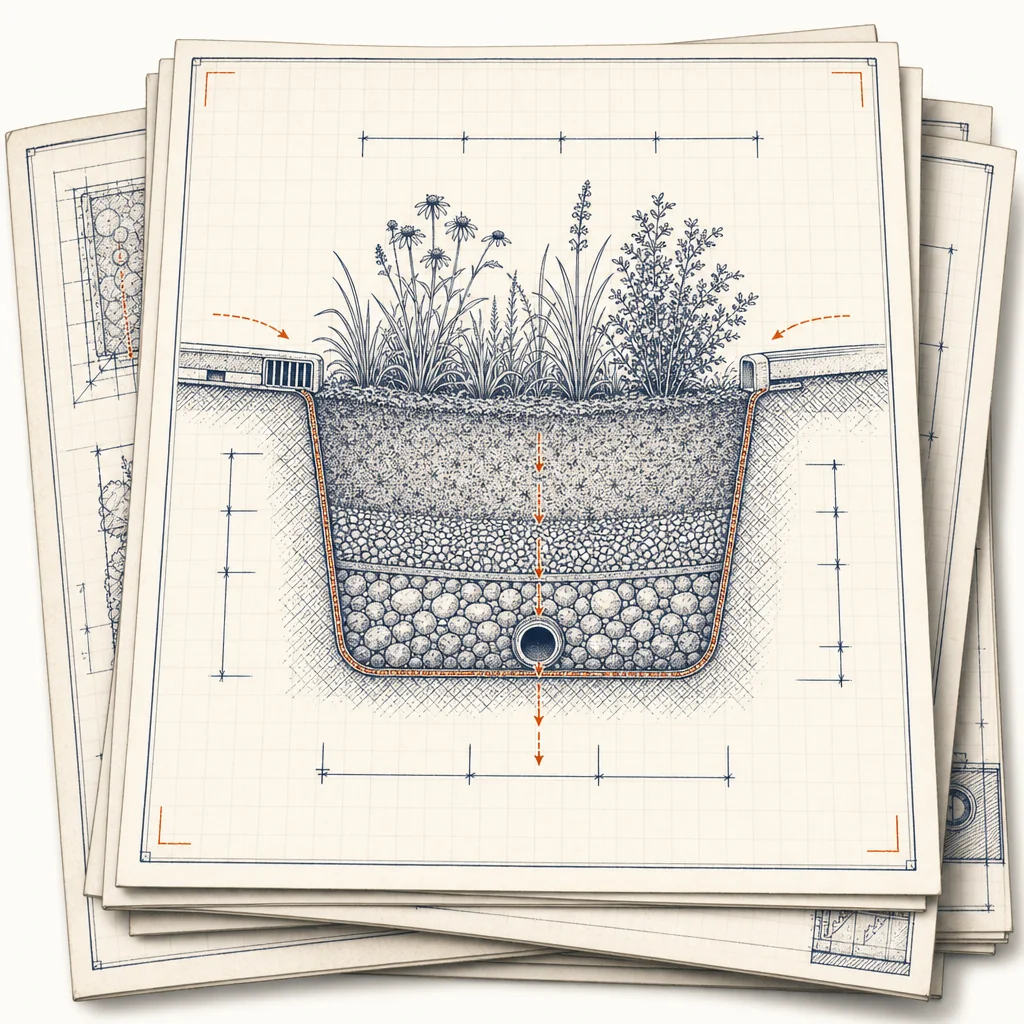
Bioretention
Bioretention areas filter runoff through a planted soil bed, combining treatment with landscaping. Covers applicability, design criteria, monitored removal and maintenance.
Filtering PracticesFilter Strip
Filter strips treat runoff as sheet flow across a band of dense vegetation, most often as pretreatment. Covers applicability, design criteria, performance and maintenance.
Filtering PracticesSand Filter
Sand filters treat runoff by settling solids in a pretreatment chamber and filtering it through a sand bed. Covers design variants, criteria, performance and maintenance.
Filtering PracticesWater Quality Inlet
Water quality inlets are underground three-chamber vaults that trap grit and oil from small paved areas. Covers chamber design, sizing, performance limits and cleanouts.
Filtering PracticesInfiltration Practices
Infiltration Basin
Infiltration basins capture the water quality volume and infiltrate it through native soils, recharging groundwater. Covers feasibility limits, design criteria and maintenance.
Infiltration PracticesInfiltration Trench
Infiltration trenches store runoff in a stone reservoir and infiltrate it into the subsoil. This fact sheet covers siting limits, design criteria, performance and maintenance.
Infiltration PracticesPorous Pavement
Porous pavement infiltrates parking-lot runoff through a permeable surface course and stone reservoir. Covers applicability, design criteria, performance and clogging prevention.
Infiltration PracticesOpen Channels
Dry Swale
Dry swales filter the full water quality volume through an engineered soil bed with an underdrain. Covers siting, design criteria, monitored performance and maintenance.
Open ChannelsGrass Channel
Grass channels are vegetated open channels sized to treat the water quality storm at low velocity. Covers applicability, design criteria, removal performance and maintenance.
Open ChannelsWet Swale
Wet swales intersect the water table and treat runoff in standing wetland cells along the channel. Covers applicability, design criteria, performance data and limitations.
Open ChannelsStormwater Ponds
Dry Extended Detention Pond
Dry extended detention ponds detain runoff for about 24 hours to settle pollutants and protect downstream channels. Covers design criteria, performance data and maintenance.
Stormwater PondsWet Pond
Wet ponds maintain a permanent pool that treats stormwater through settling and biological uptake. This fact sheet covers siting, design criteria, monitored pollutant removal and maintenance.
Stormwater PondsStormwater Wetlands
Stormwater Wetland
Stormwater wetlands pair shallow marsh zones with extended detention to treat runoff. This fact sheet covers design variants, criteria, removal performance and maintenance.
Stormwater WetlandsStream Restoration
Bank Stabilization
Bank stabilization practices combine vegetation and natural materials to hold eroding streambanks in place. Covers bioengineering techniques, design guidance and maintenance.
Stream RestorationFlow Deflection
Flow deflection practices redirect erosive currents away from vulnerable banks while concentrating flow to form pool habitat. Covers deflector types, design and construction.
Stream RestorationGrade Control
Grade control structures halt channel downcutting and rebuild a stable streambed profile. Covers structure types, design and spacing considerations, construction and maintenance.
Stream RestorationStreambank Protection
Streambank protection practices armor eroding banks where property or infrastructure is at risk. Covers rootwad revetments, imbricated riprap, boulder revetments, lunkers and A-jacks.
Stream Restoration