Specific
weights for reforestation and afforestation may differ in each application.
Assigning credit for newly planted trees is controversial, since these saplings
will take many years to become a mature forest.
Specific
weights for reforestation and afforestation may differ in each application.
Assigning credit for newly planted trees is controversial, since these saplings
will take many years to become a mature forest.Reforestation Credit
This credit is similar to the credit for Conservation of Natural Areas, except that it rewards active reforestation, rather than preservation of existing forest. This credit can apply to both reforestation and afforestation. The credit for afforestation should typically be weighted higher because the afforestation implies a net increase of forest cover on the site, while reforestation only compensates for trees cleared on site.
|
Reforestation
Credit: Summary
|
||
| Goals |
|
|
| Stormwater Management Objectives | Water Quality | Credit reforested/ afforested areas toward water quality requirements. |
| Recharge | Express as a fraction of the water quality credit. | |
| Channel Protection, Flood Control |
|
|
Example Language:
A reforestation credit shall be applied where tree planting is used to supplement existing tree cover, or to compensate for forest cleared during development. The areas in reforestation and afforestation can be applied to recharge and water quality volumes. In addition, adjustments are made to both pre-and post-developed curve numbers as a quantity control credit.
In order to receive credit, the following criteria must be met:
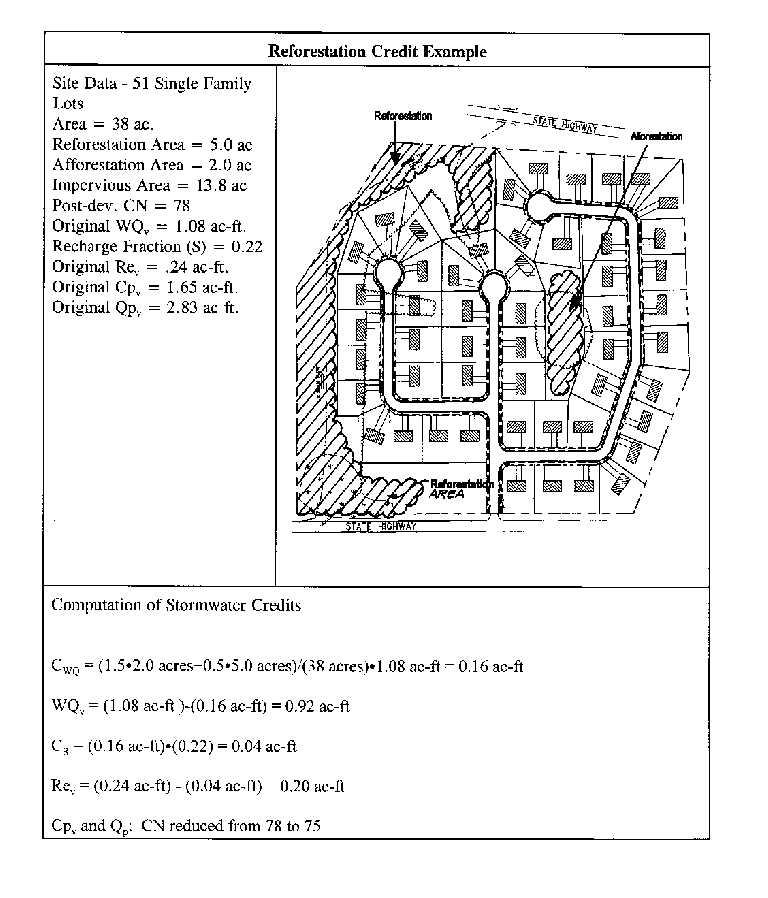
The credit for the water quality volume can be expressed based on the area in reforestation and afforestation, such that:
CWQ = (1.5AA+0.5AR)/A)(WQv)
Where:
CWQ = Reforestation
Credit for Water Quality (ac-ft)
AA = Afforestation
Area (acres)
AR = Reforestation
Area (acres)
A = Total Site Area
(acres)
WQv = Original
Water Quality Volume (ac-ft)
The credit for the recharge volume is a fraction of the water quality credit, such that:
CR = CWQ(S)
Where:
CR = Credit
for Recharge (ac-ft)
S = Recharge Fraction
(Ratio of Recharge Volume to Water Quality Volume)
The water quality and recharge volumes can then be reduced by the values of CWQ and CR, respectively.
Specific
weights for reforestation and afforestation may differ in each application.
Assigning credit for newly planted trees is controversial, since these saplings
will take many years to become a mature forest.
Modifications
to the pre-development curve number condition are only apply in communities
that require the assumption of a highly pervious land use, such as woods in
good condition. The pre-developed curve number needs to be clearly defined to
limit abuse of this credit.
The example below illustrates how this credit would be applied.